


March 2010 Issue
Afterlife of a Church
No longer serving religious congregations, these buildings now nourish their communities in inspired new ways.
We go to churches for weddings, funerals, Sunday Mass — events typically associated with a house of worship. But there’s also a church where you can buy a great new top. Or another where you can dine on more than just wine and bread. There’s even an old Ohio church building where weight-lifting equipment fills the space formerly occupied by pews and kneelers.
Increasingly, churches nationwide are closing their doors due to changes in attendance and high maintenance costs. Ohio has its fair share. Just last March the Catholic Diocese of Cleveland announced it would close 52 parishes by June 2010, leaving buildings packed with history and potential to an unknown fate.
Some of these structures will be demolished. Others will be saved through a concept called adaptive reuse, in which buildings past their prime are renovated and used for a purpose other than that for which they were originally intended. “It’s great that there is a way for these buildings to continue serving their communities. That’s why they were built in the first place,” says Alenka Banco, owner of Josaphat Arts Hall and Convivium33 Gallery, both located in the former St. Josaphat Church in Cleveland.
With adaptive reuse of church buildings, stylized architecture can be restored and neighborhood character salvaged, and the public can reap the benefits of new arts and entertainment opportunities in interesting spaces. Such examples of converted churches exist all over Ohio, and offer the chance to explore buildings you may never have set foot in otherwise.
Josaphat Arts Hall/Convivium33 Gallery, Cleveland
St. Josaphat Roman Catholic Church was built in 1915 for a small Polish congregation. Faced with the exorbitant costs of replacing the building’s roof and boiler, the church shut its doors in 1998. Enter artist Alenka Banco, who has long had an interest in religious artifacts but never imagined herself purchasing a church building. In 2002, that’s just what she did.
The building now functions as an art gallery and artists’ studio space, and is rented out for fund raisers, weddings and receptions, and community events. Banco says she undertook the many cosmetic renovations with respect to the building’s former life. The original ceiling mural was patched. Downsized versions of the wood pews still offer seating. The wide-open space lends itself well to the gallery’s art exhibits.
Banco is happy to be a part of saving something so meaningful to the community. “Former parishioners visit often. It’s very moving to hear their stories,” she says. “They’re glad they can come back.” 1433 E. 33rd St., 44114, 216/881-7838. josaphatartshall.com
Stately Raven Bookstore, Findlay
Stately Raven Bookstore houses its books and reading nooks in what used to be the Emmanuel Lutheran Church, built in 1947. The church expanded and moved on in the late ’90s. The building was home to at least two other congregations before Mike and Sharon Cole bought it in 2006. “We were looking for a unique location and a unique structure,” Mike says. After nearly a year renovating the space, Stately Raven — named “Best Spot to Read the Good Book” in 2008 by Ohio Magazine — opened in August 2007.
Bookshelves line the floor where pews once stood. The choir loft now serves as a reading loft. The large Gothic windows remain. Perhaps most memorable are the murals throughout painted by Toledo-based artist Beth Covert. Each has a literary inspiration, such as Poe’s The Raven (the book that also provided the bookstore’s name).
Cole wondered when someone would stop in to reminisce about his or her wedding in the former church. It didn’t take long. That customer came in the day the bookstore opened. 1315 North Main St., 45840, 419/427-2814. statelyraven.com
Refectory Restaurant & Bistro, Columbus
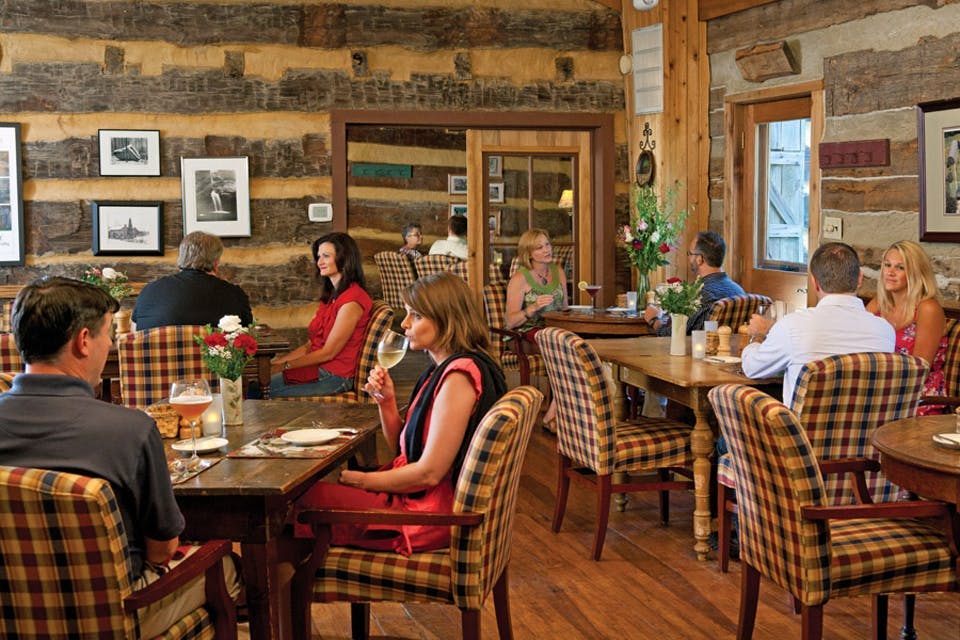
This building can’t ever again be used as a church, according to a clause written into the deed years ago. That’s OK with owner Kamal Boulos, who has been affiliated with the restaurant for more than 30 years. Built in the mid-1800s as Bethel United Methodist Church, the structure was sold in 1971 when its congregation outgrew the space. It first operated as The Olde Church-House restaurant, then was sold and re-opened as The Refectory Restaurant & Bistro in 1981.
Boulos readily admits having faced challenges with making the distinctive space work as a restaurant. “But the trade-off is that you have something so unique in terms of architecture and in terms of history,” he says. Stained glass, interior brick walls and hand-hewn wood beams overhead contribute to The Refectory’s special feel.
At one point in the building’s history, the owners planned to add a disco in the former sanctuary. Lack of funds left those blueprints unfinished — or perhaps it was divine intervention. 1092 Bethel Rd., Columbus 43220, 614/451-9774. therefectoryrestaurant.com
Faith Gym, Akron
Faith Gym owner Al Horvath says it’s natural for an old church building to work as a fitness center. “Churches bring people together and do positive things, and that’s what we do here,” he says. Located in the Akron suburb of Barberton, the gym was created in the previous Moore Memorial United Methodist Church, built in 1892. After its congregation merged with another church several years ago, the building sat vacant for a long time. Horvath rescued it in 2005.
A competitive body-building enthusiast, Horvath feels strongly that mind, body, soul and spirit intertwine. With that idea in mind, he formed Faith Gym, which opened in July of last year. He added to the religious theme throughout the building, combining concepts of faith and strength. Contributing to the uplifting feel of the place are religious paintings of Bible stories, the original stained glass, and a café and lounge for after-workout downtime. Bible study is on Wednesdays at 7:30 p.m. 185 3rd St. N.W., 44203, 330/475-0121. faithgym.org
Urban Outfitters, Cincinnati
Originally built in 1928 as Third Protestant Memorial Church, this building re-opened in 2002 as Urban Outfitters, a retail store for 18-to-30-somethings, featuring trendy clothing, housewares, gifts and accessories. Adjacent to University of Cincinnati’s campus, the building also houses a Verizon Wireless store.
The exterior is highlighted by arched doorways and windows and a gabled roof, while inside, stark shelving and ultra-modern lighting help shoppers find everything from fashions and accessories for young hipsters to oddities such as ceramic squirrel salt and pepper shakers and offbeat and risqué books that may raise some eyebrows.
But, amid the mélange of merchandise, history remains. All who enter do so under a great stained glass image of Jesus and pass by a fountain with a message reading, “When you were thirsty I gave ye to drink.” And clientele appreciate that. “Customers like the fact that the church wasn’t torn down,” says employee Cohen Gamboa. “They like the character of the building.” 2510 Ohio Ave., 45219, 513/872-0245. urbanoutfitters.com
Common in all of these stories are themes of preservation and respect — for these buildings, for the Ohio neighborhoods they served in a prior life and for the communities they serve now. As Josaphat/Convivium’s Banco says, “These buildings change the streetscape and skyline of the city forever, and when they’re gone, you can’t duplicate that, ever.”
Monday, March 08, 2010 by Amy C
Love the way the writer describes the loss of our cheerished past to gain a new life. If Churches can re-invent themselves, so can we!
Monday, March 08, 2010 by Suz
Interesting. Glad these buildings have been repurposed so we can still appreciate their history. Wonder how many like that exist in Indiana?
Thursday, March 04, 2010 by Louise Bonomo
A wonderful insight on a sad, but true change happening all over the United States. Will be sure to stop by one or two of these in our travels through Ohio.