




Printer Friendly VersionEmail A FriendAdd ThisIncrease Text SizeDecrease Text Size
August 2006 Issue

Explore Ohio's Heritage

Fascinating history awaits travelers in seven adventure-filled areas that rea just a road trip away.
Lori B. Murray

From museums and canals to nature preserves, parks and military forts, Ohio is jam-packed with historical sites. They are the basis for seven designated heritage areas located throughout the state. Each area is culturally and geographically diverse, and that means a wide range of travel adventures for all ages.

Consider scheduling some time to explore Ohio’s heritage areas. Most of these destinations have either nominal admissions or are free, and that’s good news for any travel budget. Regardless, these driving tours are an unforgettable experience, destined to transform you into an Ohio history fan forever.

Lake Erie Coastal
This heritage area is proof that Ohio really does have beachfront, complete with sandy stretches, lighthouses, maritime museums and cultural diversity. From the streets of Cleveland to the small towns that dot the coast, the shores of Lake Erie are full of fabulous historical attractions.

Begin exploring the area along Lake Erie with a stop at the Marblehead Lighthouse State Park in Marblehead. Venture to the top of the lighthouse during a guided tour. Then visit the adjacent museum, an old lighthouse residence with space dedicated to historical details and an old lighthouse lens. Constructed in 1821, this is the oldest continuously operating lighthouse on the Great Lakes. 110 Lighthouse Drive, Marblehead, 419/734-4424. Tours Mon.–Fri. 1–4:45 p.m. (May 30-Sept. 1). Donations accepted.

Learn more about this region at the Maritime Museum of Sandusky. The museum features exhibits about the maritime history of the Sandusky area, including boat building, commercial shipping, commercial fishing and recreational boating, as well as displays on ice harvesting and the boats used in Sandusky’s Underground Railroad. 125 Meigs St., Sandusky, 419/624-0274. Tues.–Sat. 10 a.m.–4 p.m., Sun. 12–4 p.m. Admission $3, seniors $2, children $2, family $6.

Located just east of Huron, Old Woman Creek National Estuarine Research Reserve and State Nature Preserve is home to a barrier beach, walking trails and visitor center. Built in 2003, the visitor/research center contains natural history exhibits, a freshwater aquarium, weather station, bird-viewing window and nature art. Exhibits include topics such as glacial geology, land use change and “green” building materials. 2514 Cleveland Rd., East, Huron, 419/433-4601. Visitor Center: Wed.–Sun. 1–5 p.m. Reserve: daily, dawn to dusk.      

Head east to the Oberlin Heritage Center and learn about the history of Oberlin, with a focus on African-American history, the Underground Railroad, women’s history, scientific discovery and various reform movements. Guided tours are given of three historic buildings: the 1836 Little Red Schoolhouse, the 1866 Monroe House and the 1884 Jewett House. 73½ South Professor St., Oberlin, 440/774-1700. Tours Tues., Thur. & Sat. 10:30 a.m. and 1:30 p.m. Admission $6, children free.

 
Holden Arboretum's Butterfly Garden Photo By Carl Stimac

The Cleveland Cultural Gardens extend along East Boulevard and Martin Luther King Boulevard in Cleveland’s University Circle area. The 23 gardens are a unique collection, each representing a different ethnic group or organization in Cleveland. Although the gardens can be seen from an automobile, they were designed to be explored by foot. 216/687-2449.

Travel farther east to Kirtland and the Holden Arboretum, celebrating its 75th anniversary this year. The Butterfly Garden, featuring a variety of topiaries, is a highlight. Other popular attractions include the Wildflower Garden (peak bloom mid-July through mid-September) and the Prairie Garden, a replication of the prairies that used to be found throughout this country. 9500 Sperry Rd., Kirtland, 440/946-4400. Daily 9 a.m.–5 p.m. Admission $6, children 3–12 $3, seniors free on Tues.

Maumee Valley Heritage Corridor
Wildlife, history, nature and the small towns along the Maumee River all characterize this heritage area. The 150-mile river is the largest flowing into the Great Lakes. This area evolved from glacier to swamp forest to the canal era of the mid- and late-1800s, and finally to its present-day state as an area rich in both agricultural and industrial heritage.     

The first stop on this tour is Sauder Village in Archbold. This is a re-created 19th-century Ohio frontier town complete with a log trading post, traditional homes, businesses and Native American dwellings. Costumed guides and working craftsmen make this visit authentic, educational and fun. A campground, modern country inn, 350-seat restaurant and exhibit halls add to the hospitality. 22611 St. Rte. 2, Archbold, 800/590-9755. Tues.–Sat. 10 a.m.– 5 p.m., Sun. 12–4 p.m. Admission $12, seniors $10.50, students $6, children 5 and under free.

Travel east to Swanton and Oak Openings Preserve, the largest of Toledo’s Metroparks. Noted for its stark contrasts in landscape, the area varies from hot sand dunes to low, wet swales. It is also home to at least 180 rare species, with 27 miles of hiking trails for exploration.

Also on site, the Beuhner Center has interactive nature displays that demonstrate the formation and unique features of the area. 4139 Girdharn Rd., Swanton, 419/407-9700. Daily 7 a.m.–dusk.

Don’t miss the Butterfly House in Whitehouse, an opportunity to see more than 500 butterflies and many different species from North and South America and Asia. Observe and learn about the life cycle of the butterfly in a relaxed garden setting. New species are introduced weekly. 11455 Obee Rd., Whitehouse, 419/877-2733. Mon.–Sat. 10 a.m.–5 p.m., Sun. 12–5 p.m. Admission $6, seniors $5, children $4.50, children under 3 free.

Nothing depicts this area better than the historic towns along the Maumee River, and the town of Maumee is no exception. Maumee was the site of several military battles, including the Battle of Fallen Timbers in 1794. In addition to a host of historical homes, visitors should take time to see the British Fort Miamis, the Wolcott House Museum, Side Cut Metropark and the Wabash Cannonball Trailhead. 419/893-5805.

One of this area’s outdoor gems is Magee Marsh Wildlife Area in Oak Harbor, consistently ranked among the top-10 birding spots in the country. It’s no surprise that the spring and fall waterfowl and songbird migrations draw the most attention. The 2,000-acre area is home to more than 300 bird species and serves as a rest area for many birds before or after they cross Lake Erie. Observe from paths, boardwalks or from a tower that overlooks the marsh. 13229 West Route 2, Oak Harbor, 419/898-0960, ext. 31. Open dawn to dusk.

Travel south to Lima and the Allen County Museum. This historical campus includes a main museum building, log house, Victorian home from the oil boom period and a children’s museum. The main museum features transportation collections, railroad history, rock and mineral displays, military and firearm displays and a gallery devoted to Native Americans. 620 West Market St., Lima, 419/222-9426. Tues.–Sun. 1–5 p.m. Donation $5.

Miami & Erie Canal Corridor
This area is all about the canal, taking visitors to a bygone era when hand-dug waterways were king. The 40-mile towpath may be the best way to re-live the adventure, with its locks, parks and wild areas, and various water control features. Still, it’s not the entire story. Small towns, with their historical museums and remarkable architecture, provide vivid lessons about the heritage of the Miami & Erie Canal.

The best way to capture this heritage area is to walk or bike the Miami and Erie Canal Towpath Trail, which extends 40 miles from Delphos to Loramie Creek. Various sections of the canal are featured along the way, along with several locks and water-control features such as the Six-Mile Aqueduct. The trail meanders through wild areas and small-town business sections, just as the canal once did. It is also part of two other major trail systems —the Buckeye Trail and the North Country Scenic Trail. 

Aside from exploring the trail, another site to see is Memorial Park in St. Marys. This park houses the Belle of St. Marys Canal Boat, a full-scale replica of a 19th-century canal boat. The park also includes a clock tower, Memorial Covered Bridge, historical markers and a scenic grotto. Visitors enjoy a close-up view of commercial buildings that were constructed adjacent to the canal. South St., St. Marys, 800/392-4883.

Travel south to Sidney and the Shelby County Courthouse. Built in 1883, the limestone, sandstone and marble used for construction were brought in by canal boat. This awesome structure looms over downtown Sidney, with a 170-foot center tower that was constructed with galvanized iron. The building was included among 125 courthouses across the country in a 1977 traveling exhibition entitled “A Photographic Document.” Downtown Sidney, 937/498-1653 or 866/892-9122.

Nearby Piqua is the location of Lock Nine Park, a greenspace with an exceptional view of the Great Miami River. The park features a partially restored lock from the Miami & Erie Canal era, and boasts excellent views of the river and levee system. A brick wall contains a pictorial history of Piqua transportation.. This park was once the site of a German immigrant settlement and industries that used canal water power to produce their goods. Water and Spring Streets, downtown Piqua. 800/348-8993.

Just outside Piqua, the Piqua Historical Area State Memorial combines a 200-acre park with the former home of John Johnston, local farmer, public official and Indian agent. The Dutch Colonial/Georgian-style farmhouse appears as it did in 1829. Not far from the farm is a museum that resembles the blockhouse style of Fort Piqua, General Anthony Wayne’s 18th-century supply post. Visitors can view a restored section of the Miami and Erie Canal from the patio. 9845 North Hardin Rd., Piqua, 800/752-2619. Wed.–Sat. 9:30 a.m.–5 p.m., Sun. 12–5 p.m. Admission $7, children 6–12 $3, children 5 and under free.

In nearby Troy, the Museum of Troy History is housed in the restored Civil War-era home of John Kitchen. The museum features household items covering the period from 1850 to 1950. Rotating displays are based on various lifestyle themes, such as sports, religion, industry and health care. Also on display are numerous artifacts from Troy-area businesses. Across the street, the Overfield Tavern Museum is an 1807 log cabin that houses a collection of early 19th-century household furnishings. 124 East Water St., Troy, 937/335-4188. Sat.–Sun. 2–4 p.m. and by appointment. Admission free.

Ohio & Erie Canalway
The Ohio & Erie Canal helped boost Ohio’s econ-omy by transform-ing what was once frontier land into a booming and populous state. With such diversity in one heritage area, visitors are quickly and easily transported from big-city life to rural byways. Along the Canalway, you’ll experience trails and trains, canal towns and industrial neighborhoods, rivers, lakes and wide-open spaces.

Cleveland’s West Side Market is a favorite for food lovers and cultural history buffs alike. This market began in 1912, and today more than 100 vendors sell their goods, such as ethnic foods, spices, smoked meats and fresh fruits and vegetables. A visit to the market uncovers Cleveland’s cultural diversity and historical role of immigration in this community. 1979 W. 25th St., Cleveland, 216/664-3386. Mon. & Wed. 7 a.m.–4 p.m., Fri.–Sat. 7 a.m.–6 p.m.

Also in Cleveland, the Western Reserve Historical Society is home to several attractions at its headquarters at University Circle. Begin at the Crawford Auto-Aviation Museum, with its nearly 200 vintage and antique automobiles and airplanes. Also on site, the Halle Costume Wing has more than 30,000 garments from the late 1700s to the present, and finally, the Hay-McKinney Mansion is a 1911 home with turn-of-the-century parlors and living spaces. 10825 East Boulevard, Cleveland, 216/721-5722. Mon.–Sat. 10 a.m.–5 p.m., Sun. 12–5 p.m. Admission $8.50, seniors $7.50, children 3–12 $5, children 2 and under free.

In the nearby villages of Valley View and Cuyahoga Heights, the Ohio & Erie Canal Reservation makes its way along a portion of the waterway. Stark contrasts exist between pipelines and steel mills and the beautiful fields and forests of the Cuyahoga River Valley. This is a great place for fishing and hiking, with a 7.2-mile Towpath Trail that links the reservation with the Cuyahoga Valley National Park. At the Leonard Krieger CanalWay Center, indoor exhibits and interpretive programming explain the area and its history. 4524 E. 49th St., Cuyahoga Heights, 216/206-1000. Center: daily 9 a.m.–5 p.m. Park: daily 6 a.m.–11 p.m.

Travel south to the town of Bath and Hale Farm & Village, a living-history museum and working farm from 1861. Watch skilled artisans and costumed interpreters demonstrate glassblowing, blacksmithing, spinning, weaving, candle making and basket making. One of the summer’s biggest events is the Civil War re-enactment scheduled for August 12 and 13. 2686 Oak Hill Rd., Bath, 800/589-9703. Summer hours: Wed.–Sat. 11 a.m.–5 p.m., Sun. 12–5 p.m. After Labor Day: limited hours weekdays, open weekends. Admission $14.50, seniors $12.50, children 3–12 $7.50.

Farther south, Zoar Village is a restored 1817 community that was settled by German immigrants who came to this country seeking religious freedom. They lived communally until 1898, leaving behind one of the quaintest villages in the country. There are 10 restored buildings in all. Each month at Zoar, a different theme is introduced, such as dairy or bakery. Located 2.5 miles east of I-77 (exit 93) on St. Rte. 212, 800/874-4336. Wed.–Sat. 9:30 a.m.–5 p.m., Sun. 12–5 p.m. Admission $7, children 6–12 $3, 5 and under free.

Finally, the Warther Carving Museum tells the delightful story of its founder, Ernest Warther, a man who slept little and carved wood nearly every waking moment he was not working. Warther’s tremendous attention to detail is found in all of his work, but especially in the 64 carvings that depict the history of the steam engine. The recently expanded building and new videos and viewing theater capture Warther’s life and works, while the surrounding gardens with 6,000 annuals are a must-see. 331 Karl Ave., Dover, 330/343-7513. Daily 9 a.m.–5 p.m. Admission $9.50, children 7–17 $5.50, children 6 and under free.     

Ohio Hill Country
The pace slows a bit in this part of Ohio, making it a popular vacation destination both for Ohioans and visitors from other states. As you explore this heritage area, you’ll view dramatic hills and steep gorges, waterfalls, lakes and rivers. At the same time, you’ll learn about the people and industries that have dominated this area — both today and in the past. 

Begin your adventure in Amish Country at the Amish and Mennonite Information Center in Berlin. The 265-foot cyclorama (mural-in-the-round) is a must-see before venturing into Amish country. It outlines the history and beliefs of the Amish/Mennonite people. A Civil War-era schoolhouse and a mid-1800s-style pioneer barn are both new at the center.  5798 Co. Rd. 77, Berlin, 877/858-4634. Mon.–Thur. 9 a.m.–5 p.m., Fri.–Sat. 9 a.m.–8 p.m. Admission $8.50 (all three attractions), children $5.

Travel through Amish Country and then head south toward Noble County and the town of Caldwell. This is the home of the Baker Family Museum, one of the largest private collections of glassware and antiques in the country. See glassware from area manufacturers, including Cambridge, Fenton and Heisey, as well as pottery from Weller, Shawnee and Roseville potteries. Add to that a collection of porcelain china from two German companies, antique firearms, pocket watches, railroad items and primitive American antiques. 805 Cumberland St., Caldwell. 740/732-6410. Wed. & Thur. 9 a.m.–4 p.m., Fri.–Sat. 9 a.m.–5 p.m. Admission by donation.

One of Ohio’s newest attractions is the Ohio Glass Museum in Lancaster. This 12,000-square-foot museum features glassware from all over the state; however, one gallery is dedicated exclusively to the 49 glass companies that once prospered in this area. Highlights include a gift shop, history gallery, special exhibit gallery, glass-blowing studio, interactive display area and industrial exhibit area. 126 W. Main St., Lancaster, 800/626-1296. Tues.–Sun. 1–4 p.m. Admission $4, seniors $3, students $2, children $1.

Venture to south-central Ohio and the town of Chillicothe. The Pump House Center for the Arts, located in Yoctangee Park, is a cultural center with changing exhibitions. Located in the historic Pump House and Water Works (built in 1882 and at one time the main pumping facility for Chillicothe), it houses both an exhibit gallery and gift gallery. Shows change every four to six weeks and feature the work of area artists. Enderlin Circle in Yoctangee Park, Chillicothe, 740/772-5783. Tues.–Fri. 11 a.m.–4 p.m., Sat.–Sun. 1–4 p.m. Admission free.

Also in Chillicothe is Adena,  the mansion of Thomas Worthington, Ohio’s sixth governor and one of the state’s first senators. Situated on 300 acres are the house, five outbuildings and extensive formal gardens. The house was designed by Benjamin Henry Latrobe, considered to be the first professional American architect, who designed the U.S. Capitol under President Jefferson. Located on Adena Road off Pleasant Valley Road, northwest of the intersection of St. Rte. 104 and U.S. Rte. 35, 800/319-7248. Wed.–Sat. 9:30 a.m.–5 p.m., Sun. 12–5 p.m. (April 1–Oct. 31). Admission $7, students $3.

Finally, Adams County is home to the Great Serpent Mound, the largest and finest serpent effigy in the country. It sits high on a plateau overlooking the Brush Creek Valley, and is almost one-quarter-mile long and averages three feet in height. Shaped like an uncoiling serpent, it dates back to the Adena and Fort Ancient cultures. A museum contains exhibits on the effigy mound and surrounding area. 3850 St. Rte. 73, Peebles, 800/752-2757. Wed.–Sun. 10 a.m.–5 p.m. Parking $7.

Ohio’s Historic West
This eight-county heritage area in the west-central part of the state does an excellent job of telling the story of the American experience. With so much cultural and ethnic diversity, the area’s farms and rural lifestyle, scenic beauty, small towns and local heroes combine to celebrate Americana. Be a present-day pioneer as you travel the back roads and main streets that meander through this unique Ohio heritage area.

Begin this adventure in Wapakoneta at the Neil Armstrong Air & Space Museum. The museum documents Ohio’s contribution to the history of flight and space travel, including the space shuttle program and the International Space Station. Some of the items on display are an F5D Sky Lancer, the Gemini VIII spacecraft, Apollo 11 artifacts and a moon rock. Recent renovations include the addition of interactive exhibits with a space shuttle landing simulator and a lunar landing simulator. 500 South Apollo Dr., Wapakoneta (exit 111 off I-75), 800/860-0142. Tues.–Sat. 9:30 a.m.–5 p.m., Sun. 12–5 p.m. Admission $7, children 6–12 $3, children 5 and under free.

A short distance to the south is New Bremen and the Bicycle Museum of America. Dedicated to the history of cycling, the museum features more than  250 vintage bicycles. Recent acquisitions include an 1899 Knoll, an 1890 New Era, an 1898 Rex Cycle and a 1901 Wolf-American. This summer the museum is one of 100 locations nationwide featuring the work of Viktor Schreckengost. 7 West Monroe St., New Bremen, 419/629-9249. Mon.–Fri. 11 a.m.–7 p.m., Sat. 11 a.m.–2 p.m. Admission $3, seniors $2, students $1.

Travel to the edge of the state to see Fort Recovery State Memorial, which includes two reconstructed blockhouses with connecting stockade, a monument and a museum. It all stands as a reminder of the 1791 battle between General Arthur St. Clair’s forces and the Miami Indians. Nearly three-quarters of St. Clair’s men were killed or wounded in the Indian attack. Just two years later, General Anthony Wayne’s army arrived to build a four-blockhouse post at the site, and one year later they defeated a huge Indian force. 1 Fort Site St., Ft. Recovery, 800/283-8920. Daily 12–5 p.m. Admis-sion $3, children 6–12 $1, children 5 and under free.

The next stop is the Darke County Nature Center and Shawnee Prairie Preserve. The preserve was once known as Prophetstown, the village founded by The Prophet (Tecumseh’s brother) and formed to rally 15 woodland Indian nations to gather and demonstrate their living and hunting rights under the 1795 Treaty of Greene Ville. Today the landscape is wetlands, restored prairies, streams, wet woods and swamp forest, with 2-½ miles of trails. 4267 St. Rte. 502 West, Greenville, 937/548-0165. Park: daily sunrise to sunset. Nature Center: Mon.–Sat. 9 a.m.–5 p.m., Sun. 1–5 p.m.

Travel east to Springfield, home of Frank Lloyd Wright’s Westcott House. In 1909, auto magnate Burton Westcott commissioned the famous architect to design the 4,000-square-foot house in the community’s most prestigious neighborhood. The structure was recently restored at a cost of $5 million, and today is open to the public as the only example of Wright’s famous Prairie-style architecture in Ohio. 1340 E. High St., Springfield, 937/327-9291. Wed.–Sat. 11 a.m.–5 p.m., Sun. 1–5 p.m. Admission $8.50, seniors $7, students $6.

The last stop on this tour is Ohio Caverns in West Liberty, a short distance north of Springfield. One-hour tours of the underground caves are available, with each tour one mile in length and featuring several stalactite and stalagmite formations. These are the largest caverns, as well as the oldest tourist attraction, in the state. 2210 E. St. Rte. 245, West  Liberty, 937/465-4017. Daily 9 a.m.–5 p.m. Admission $10.50, children $5.50.

Southwest Ohio Heritage Area
From Cincinnati to Dayton and the small towns in between, this is an area of the state that tells the story of the struggle for liberty and human rights. Rich in both ancient and modern history, there are many museums, memorials, educational institutions and towns waiting to be explored.

Jump-start this heritage adventure at the National Underground Railroad Freedom Center in Cincinnati. The Center not only addresses the efforts of the Underground Railroad, it also focuses on current struggles and heroes from around the world. Exhibits, programs, research and interactive experiences combine to facilitate this learning experience for visitors. Beginning in early September, an exhibit of 9/11 memorabilia from New York City will be on display. 50 East Freedom Way, Cincinnati, 513/333-7500. Tues.–Sun. 11 a.m.–5 p.m. Admission $12, seniors $10, children $8, children under 3 free.

Also in Cincinnati, the Harriet Beecher Stowe House operates as a historic and cultural site where individuals can learn about the author and her family and friends, the Underground Railroad, women’s rights, abolitionists and African-American history from the 1830s to 1860s. Harriet Beecher Stowe lived in this house with her family from 1832 to the early 1850s, prior to her marriage. 2950 Gilbert Ave., Cincinnati, 513/751-0651. Tues.–Thur. & Sat. 10 a.m.–3 p.m. Admission free.

Travel a short distance northeast to Wilmington, the home of Wilmington College. Visit the Quaker Heritage Center, an educational center devoted to the story of the Quakers in southwest Ohio, including why they came, what they did and why they stayed. Explore the daily lives and religious beliefs of these people, as well as their link to the rest of the world. A permanent exhibit outlines the history of the Quakers in this area, while a separate gallery features rotating exhibits. College Street, Wilmington College, Wilmington, 937/382-6661 ext. 719. Mon.–Fri. 9 a.m.–4 p.m. Admission free.

In neighboring Oregonia, Fort Ancient State Memorial is North America’s largest prehistoric Indian hilltop enclosure. It features 18,000 feet of earthen walls built 2,000 years ago by American Indians who used primitive tools for construction. In the museum, interactive exhibits tell the history of 15,000 years of American Indian history in the Ohio Valley. 6123 St. Rte. 350, Oregonia, 800/283-8904. Wed.–Sat. 10 a.m.–5 p.m., Sun. & holidays 12–5 p.m. Admission $7, children 6–12 $3, children 5 and under free.

North, off I-75, is the town of Franklin, home to a series of murals painted by local resident and nationally known muralist, Eric Henn. The Franklin Murals are primarily located along Main Street, but some have been painted on the interior of local buildings. These murals have a historical focus, including the newest, which pays homage to a local bridge. 937/746-8457 or 800/617-OHIO.

Finally, no trip to this heritage area would be complete without visiting the National Museum of the United States Air Force. This amazing collection of aircraft spans the time from early flight and the Wright Brothers through World Wars I and II, the Korean and Vietnam Wars and Desert Storm. The museum’s IMAX Theater presents films that provide an educational and entertaining journey through aviation history. 1100 Spaatz St., Wright-Patterson Air Force Base, Dayton, 937/255-3286. Daily 9 a.m.–5 p.m.  Museum admission free, call for IMAX price.

 Lincoln Highway: Our Nation's Main Street


There is perhaps no better example of yesteryear than the small towns and historic landmarks found along the Lincoln Highway, the first transcontinental automobile route in the United States. The Lincoln Highway was conceived in 1913 by pioneers in the auto industry who believed that better roads meant more travel by automobile, a pastime that previously was enjoyed only by the privileged upper class.

Travelers today can venture the 241 miles from East Liverpool to Van Wert via the Lincoln Highway, and rediscover miles of early auto-era remnants that outlived their time period, including remodeled motor hotels and restaurants, gas stations, theaters and drive-ins. The following is just a sampling of what visitors can expect to see.

In East Liverpool, the Point of Beginning Marker signifies the initial survey point for everything west of the Ohio River. About 20 miles west is Baywood Street, a stretch of original Lincoln Highway brick road that is still intact — a true picture of what the road was like in its heyday. In the Canton area, major attractions such as  the Pro Football Hall of Fame, National First Ladies’ Library and Canton Classic Car Museum are not necessarily reminiscent of the original highway, but they are well worth the stop. Also in Canton, the Landmark Building still stands; originally, it was an inn on the path that became Tuscarawas Avenue in Canton and later the Lincoln Highway.

Farther west, in the tiny town of Leesville, the J & M Trading Post, built in 1834, is now an antiques shop. In Bucyrus, the Hopley Monument is made of stones from all over the world, and is dedicated to John E. Hopley, the Lincoln Highway’s first Ohio consul. As visitors get closer to Indiana, the town of Gomer, once a major settlement of Welsh culture, showcases the Gomer Welsh Museum and an unusual collection of materials chronicling the transport of Admiral Byrd’s snow cruiser along the Lincoln Highway. In the many county seats along the way, architecturally unique courthouses such as those in Wooster and Van Wert make their mark. Finally, in Delphos, the Delphos Canal Museum houses artifacts that tell the story of life in a canal town during the mid-1800s.


The National Road: An All-American Experience


The inspiration of a group of our nation’s founding fathers, the National Road was the country’s first federally funded interstate highway. Beginning in Baltimore, Maryland, and extending 700 miles to St. Louis and the Mississippi River, the National Road spans six states. In Ohio, it covers close to 228 miles, extending from Bridgeport in the east to the Indiana state line near Richmond. Today, it serves as a timeline of nearly 200 years of history.

Visitors can explore many historic treasures along the road, guided by red, white and blue markers that are strategically placed along U.S. Rte. 40. Note that U.S. 40 and I-70 have bypassed much of the original road. Along the way, history unfolds, as does the landscape, ranging from the rolling hills of eastern Ohio to the flatter, fertile farmland in the western part of the state. Here is a brief peek into the sites along the National Road. 

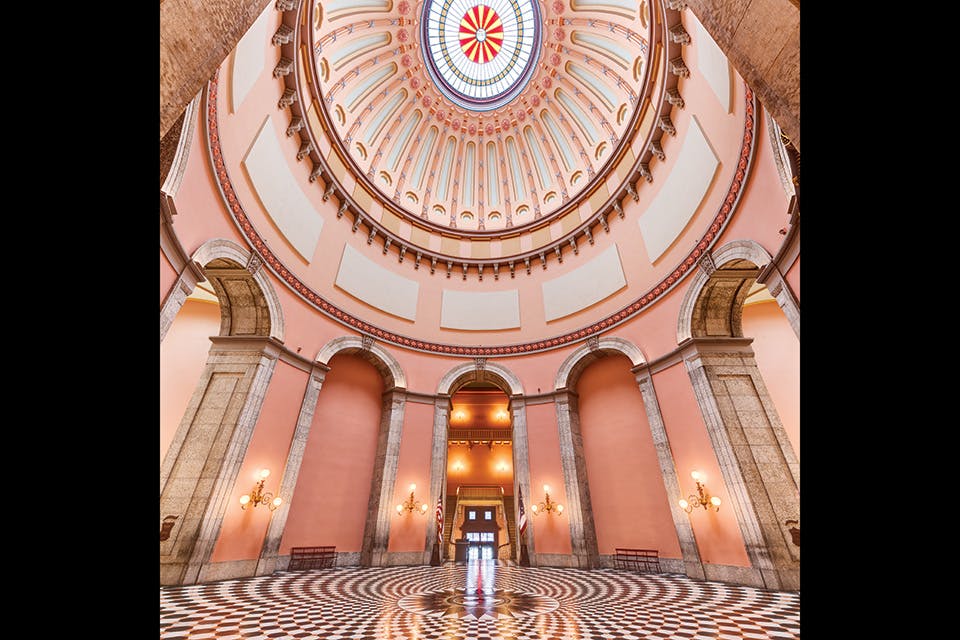
In Blaine, the Blaine Hill Bridge is famous for being the oldest documented standing bridge in Ohio. It spans Wheeling Creek, a tributary of the Ohio River. Farther west, the town of Old Washington is the site of the only Civil War skirmish on the National Road in Ohio. It took place in 1863 when John Hunt Morgan and his Confederate Cavalry stopped in the village to look for food. While dining, they were attacked by Union forces. In Muskingum County, the John and Annie Glenn Historic Site in New Concord is a must-see, housed in John Glenn’s boyhood home. In nearby Norwich, the National Road/Zane Grey Museum is the only museum along the route that was specifically created to feature National Road history, complete with a diorama, photographs and exhibits. In Columbus, don’t overlook the Ohio State House. Constructed between 1839 and 1861, it is considered one of the finest examples of Greek Revival architecture in the country.

The road reached Springfield in 1838, bringing with it many inns and taverns for the road-weary traveler. The Pennsylvania House is a Federal-style inn and tavern that was completed in 1839. It has been fully restored and still operates today. Also in Springfield, the Clark County Heritage Center, City Hall and Market were completed in 1890 and currently house the collections of the Clark County Historical Society.

Tourist camps were another important part of the evolution of the road. Garfield Grove in Donnelsville is an excellent example of a 1930s tourist camp that in the 1950s still included cottages, a gas station and a restaurant. Remnants of this tourist camp can still be seen today.  

 
Related Categories


Subscribe
COMMENTS
Be the first to leave a comment.
ADD YOUR COMMENT


Copyright © 2013 Ohio Magazine All rights reserved. | webmaster@ohiomagazine.com
1422 Euclid Avenue Ste. 730 Cleveland OH 44115