





June 2006 Issue
Inspired by Salem
From the vivic artistry of a local who's considered "Ohio's Van Gogh," to the secret passageways and distinct faith that hint at the town's past, Salem's rich heritage turns visitors into enthusiasts.
There's no mystery as to whether or not the spirit will move you in Salem. (Of course it will.)
Rather, the anticipation lies in trying to figure out when it will strike - and how you'll respond once it does.
For Margaret Starbuck, it happened while at church one Sunday in April, at 10:45 a.m. That morning, the sky over Salem mimicked a light switch: A mass of shifting clouds cleared a path for the sun one moment, kindly allowing warm rays to bathe the town - before unceremoniously huddling up again the next, blocking out the brightness. Inside the Friends Meeting House on Sixth Street, the touch-and-go sunshine went unnoticed: Margaret Starbuck and 12 other parishioners were waiting for a bit of divine light.
There is no preacher at the 134-year-old church, no pulpit, no choir and no stained glass - the Quaker congregation is free of anything that might interfere with a direct, personal connection with God, with members opting to spend an hour in quiet contemplation, hoping to hear His voice in the silence. They say that sometimes, His message is only meant for the individual; other times, it is to be shared with the rest of the congregation. Either way, Starbuck thought, patiently sitting in a pew with her Bible on her lap, one must wait to be moved by the spirit.
At 10:45 a.m., it moved her.
Starbuck suddenly rose from her pew, Bible in hand, and began reciting a Psalm out loud.
"You have to give Him a chance to talk to you," she would later say, explaining the church's style of worship. "Then, you have to let the spirit do the guiding."
Someone should paint that on a "Welcome" sign at the entrance to town.
After all, it's one thing to see Quakers in Salem infused with spirit: They've practiced their traditions in this Columbiana County locale ever since founding it 200 years ago.
But with so many of its citizens, regardless of their faith, being led by pure inspiration - seemingly moved to act by just the essence of the place - "Let the spirit do the guiding" could be Salem's official motto.
A note of caution: A trip to Salem tends to turn curious visitors into loyal residents. Just ask Mitch Lynch. Four years ago, Lynch and his wife, Patricia, ran a dog-walking service 2,500 miles away in San Francisco. They had an urge to move closer to family after the events of 9/11, and Patricia's relatives are from Youngstown, but the couple had no particular Ohio spot in mind.
Today, you'll find them running their own coffee shop and bakery, Friends Roastery, on State Street, where the walls display enough artwork to have the space double as a gallery, thanks to Lynch's interest in promoting Salem's artists.
"There's great architecture here, and this area is such an important part of Ohio's history," says Lynch. "That was a big attraction for me."
Another warning: Once you do become a resident, any hobby you have may turn into a full-blown passion. Take Richard Wootten. He certainly already had an interest in artwork before moving here: He was a noted art critic at The Cleveland Press before it went out of business in 1982. Still, when he came to Salem more than 20 years ago after his wife took a teaching job in the area, Wootten had no immediate plans, happily indulging such random interests as playing the piano and coaching a lacrosse team. That is, until he learned about the life of one of Salem's most famous former residents, Charles Burchfield, a widely respected but often overlooked artist who used his modest neighborhood on Fourth Street as the subject of countless watercolor paintings - works that quietly hang in some of the world's most revered museums.
Today, Wootten is the president of the Burchfield Homestead Society and has made it his mission to return the artist's home to the state it was in when Burchfield lived there between 1898 and 1921 (right down to the butterscotch-colored exterior). In 1999, it was opened to the public as The Burchfield Homestead Museum, where visitors can peruse dozens of copies of works, strategically hung next to the same windows through which the artist once stared, allowing guests to compare modern-day views of Salem to the ones Burchfield captured in the early 20th century.
"Isn't it great?" says Wootten, referring to Salem. "This place wasn't infected with all the urban renewal that occurred in the 1960s, when so many well-meaning architects and city planners messed up a lot of towns. It's still got its integrity - not just architecturally, but in a lot of ways. You can see why Burchfield loved it."
The essence that seems to endear so many transplants who wander in and find themselves among the nearly 13,000 faithful residents can largely be attributed to the rich, historic atmosphere that permeates Salem - from the retail stores downtown, housed in stately, Civil War-era buildings, to the private residences that once belonged to abolitionists, some of which still bear features that hark back to the town's former life as an important stop on the Underground Railroad.
"There's this one house in town that still has a fireplace with metal doors on each side of it," says Salem historian Dale Shaffer. "There's just enough room there to crawl through those doors, and then they have a wall behind them. You could hide fugitive slaves there, and have a fire burning in the fireplace at the same time, and no one would ever know."
You'd hardly need to tour those homes to realize that Salem was a sanctuary for runaway slaves at a time when so much of the country was trying to keep them in chains. Simply put, it's all in the name: "Salem" derives from the word "Jerusalem" and means "peace," and that's exactly what Quakers John Straughan and Zadok Street intended for it when they founded the town 200 years ago - a fact that will be celebrated June 25 through July 16, when Salem honors its bicentennial with a series of concerts, festivals, tours and theatrical performances. (For history enthusiasts, Salem will also host "Ohio Chautauqua," featuring a wealth of free educational workshops and performances by living-history interpreters under this year's theme of "War and Peace," July 18-22.)
"We believe that the spirit of the Lord is in every person, which is why we object to killing and believe in protecting people who can't help themselves," says Starbuck, a devoted Quaker who on Sundays travels to the Friends Meeting House from her home at Copeland Oaks Retirement Community in Sebring, where several fellow parishioners also live.
"The first Congress after our country was established said that this territory would not have slavery, so that was a huge reason for members of the Society of Friends to come here," says Starbuck, using the other name by which Quakers are commonly referred. "There were Friends in Virginia, North Carolina and Maryland, and they were very unhappy living where there were slaveholders, so when they moved to Salem, suddenly there was this network of people here ready to take in those being persecuted."
The religion's principles of equality not only made the town the western headquarters of the Anti-Slavery Association, but also the site of the first women's suffrage convention in Ohio (and only the second one in the nation).
While the Quaker population has diminished here, the legacy remains - and not just in the businesses that have the word "Friends" in their titles (such as Lynch's coffee shop) or in the namesake Salem Quakers high school athletic teams.
"This town is still a really peaceful community today; I think that atmosphere has kind of been carried down from generation to generation," says Shaffer.
The historian is yet another example of someone who, years ago, fell under the town's engaging spell, and is now dedicated to preserving its past and promoting its heritage.
"Well, I used to be an economics professor," Shaffer says with a chuckle, recalling his life before he became immersed in the town's history. The Salem native once taught at several colleges in West Virginia, and even started a community college in New Jersey with a group of educators. Some 25 years ago, though, he came back to town and wrote a newspaper article on the history of a local school.
"People liked it and seemed to be real interested in the area, and one thing led to another, and you know how that goes …"
Today, Shaffer writes books about Salem the way other people write grocery lists. "Twenty-two so far, and I'm working on another one right now," he says.
While the area's history is rich enough to be the source of so many books, Shaffer notes that Salem's charm - accented by touches such as the attractive, old-fashioned lamps that line downtown - also holds more than a bit of sway for visitors.
"This still is, to a large extent, small-town America," he says. "If Norman Rockwell were around, he could come here and do some of his paintings."
Sure, Rockwell could pay a visit. But for the record, as far as art goes, Salem will always be considered Burchfield Country.
At first glance, the scene on Fourth Street one late afternoon yields only tidy homes and a stream of backpack-toting kids riding bikes, taking shortcuts through the alleys that crisscross the neighborhood. You'd be forgiven for not immediately recognizing what noted art historian Henry Adams called "a building of extraordinary significance."
"I cannot think of another building in America which has inspired so many masterpieces, or which has played such a key role in a great artist's imaginative vision," he said of Burchfield's home.
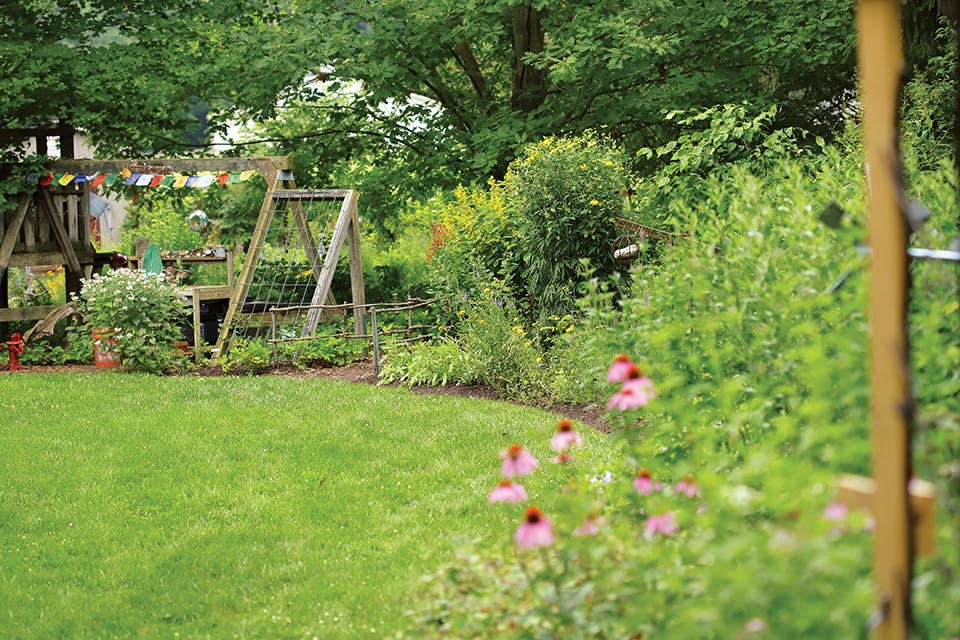
Take a peek at the back yard in the summertime, and suddenly Burchfield's imagination and inspiration begin to take shape. Lemon lilies, gladiolas, cotton-candy-colored morning glories, sunflowers, a grape arbor - members of the Burchfield Society have faithfully recreated the vibrant garden that the artist once maintained here. Between the dozens of works hanging throughout the house that show views of his beloved hometown, and the brilliant splashes of color blossoming in the re-created garden, the Burchfield Homestead Museum has become a destination spot for art lovers from as far away as Japan and Australia.
"He was called an animist, and he really did animate everything he saw," says Wootten. It's no wonder that the passion visible in his paintings tends to draw comparisons to those of Vincent Van Gogh: Burchfield's images practically pulsate with life, including foliage that seems to undulate on the canvas.
The artist's love of nature and affection for Salem can lure collectors to pay nearly $1 million for his works, and the Salem Library is fortunate enough to be home to an original, "Three Trees," that depicts a wooded spot in town where Burchfield played with friends during his childhood.
"There's so much energy in his paintings, you can see how filled with wonder he was of everything around him," says Wootten. "It's as if every day he woke up looking at the world around him through a new pair of eyes."
While the paintings are certainly awe-inspiring, perhaps the fact that Burchfield was able to create dynamic works out of what some would consider ordinary scenes of Salem, really isn't that unusual. Things like that tend to happen in a town where inspiration is a guiding force.
When You Go...
The Salem Historical Society Museum, 208 S. Broadway Ave., Salem, 330/337-8514. www.salemohio.com/historicalsociety. Sunday afternoons, May-October.
The Charles Burchfield Homestead Museum, 867 E. Fourth St., Salem, 330/332-8601. www.salemohio.com/burchfield. Sundays May-November, 1-4 p.m., or call for an appointment
Friends Roastery, 474 E. State St., Salem, 330/337-6962. www.friendsroastery.com. Mon.-Fri. 7 a.m.-4 p.m., Sat. 7 a.m.-1 p.m., Sun. 8 a.m.-1 p.m.
For a complete list of activities and events for the Salem Bicentennial or Ohio Chautauqua, contact the Salem Chamber of Commerce at 330/337-3473, or visit www.salemohiochamber.org.
Be the first to leave a comment.