


Printer Friendly VersionEmail A FriendAdd ThisIncrease Text SizeDecrease Text Size
February 2009 Issue

Lincoln in Ohio

He may not have been born here or ever lived here, but the 16th president had strong connections to the Buckeye State.
Lincoln in Ohio
If, in honor of the 16th president’s 200th birthday, someone decides to throw a States Important to Abraham Lincoln Contest, a few of our neighbors might have a slight edge on Ohio. Illinois goes without saying.

Kentucky? He was born there on Feb. 12, 1809, in a cabin that no longer exists (but a reasonable facsimile of it can be viewed at a national park near Hodgenville, in the central part of the state).

Indiana? Well, it gets points for having another of his homes. Abe spent his teen years with his family in southern Spencer County.

But after that, Ohio can proudly claim as many Lincoln connections as anywhere else — based on the fact that the state was a key player in nearly all national affairs during the troubled time of the great man’s administration.

Lincoln visited Ohio several times to make speeches, met one of his most trusted allies here, recruited some of his key generals from here and also encountered his stiffest resistance to the war effort from here. Ohio also played a memorable role in Lincoln’s farewell funeral tour.

As the nation marks the 200th anniversary this month of Lincoln’s birth in that remote Kentucky county, all these things seem to take on even greater significance.

His speeches here were important.

As many folks know, Lincoln became a national political figure deemed worthy to head to the White House after the famous Lincoln-Douglas debates of 1858, in which Abe talked his way across Illinois in a series of rhetorical duels against Stephen A. Douglas, with a U.S. Senate seat the prize.

Lincoln lost that seat, but remained a popular national speaker; he toured Ohio in 1859, addressing crowds in Columbus, Dayton, Cincinnati and Hamilton on Sept. 16 and 17, according to biographer David Herbert Donald, who said the speeches were continuations of the same anti-slavery themes that had already made him famous. The speeches drew considerable national attention.

“Reminding his Ohio audiences,” Donald writes, “that ‘at an early age, I was myself a hired laborer, at twelve dollars per month,’ he insisted that in a free society there was ‘no such thing as a man who is a hired laborer, of a necessity, always remaining in his early condition.’” As slaves were forced by society to do, in other words.

“The warm reception that Lincoln’s speeches received in Iowa, Ohio, Indiana, Wisconsin and Kansas during the last half of 1859,” Donald adds, “gave plausibility to suggestions that he ought to be nominated to high office ... [A] November 6 story in the Sandusky Commercial Register calling on Republicans to nominate Lincoln (for the presidency) received more attention.” If nothing else, it’s interesting to imagine a day when an editorial in a small paper in Sandusky, Ohio, could stir up national political forces.

He passed through after his victory.

Lincoln’s train trip from Springfield, Illinois, to the White House in early 1861 took him through southern Ohio, and provided a number of memorable stops.

Cincinnati greeted Lincoln with a large, enthusiastic crowd and a warm greeting from the mayor. The city was known for mixed sympathies on the matters of slavery and secession, and his words there were closely scrutinized.

The inaugural train “crawled through the rest of the broad state of Ohio,”

according to Harold Holzer’s new book Lincoln President-Elect. At every town, “crowds routinely greeted Lincoln with artillery salutes, band music, and rousing cheers. He gamely offered lighthearted acknowledgement ‘wherever the iron horse stops to water himself,’ he joked at one such refueling spot.” Despite having a cold and a sore arm from all the handshaking, “he continued obligingly, croaking a few words at Milford, Loveland, Miamiville, Morrow, Corwin, Xenia (where well-wishers ‘acted more like crazy people than American citizens’), and London.”

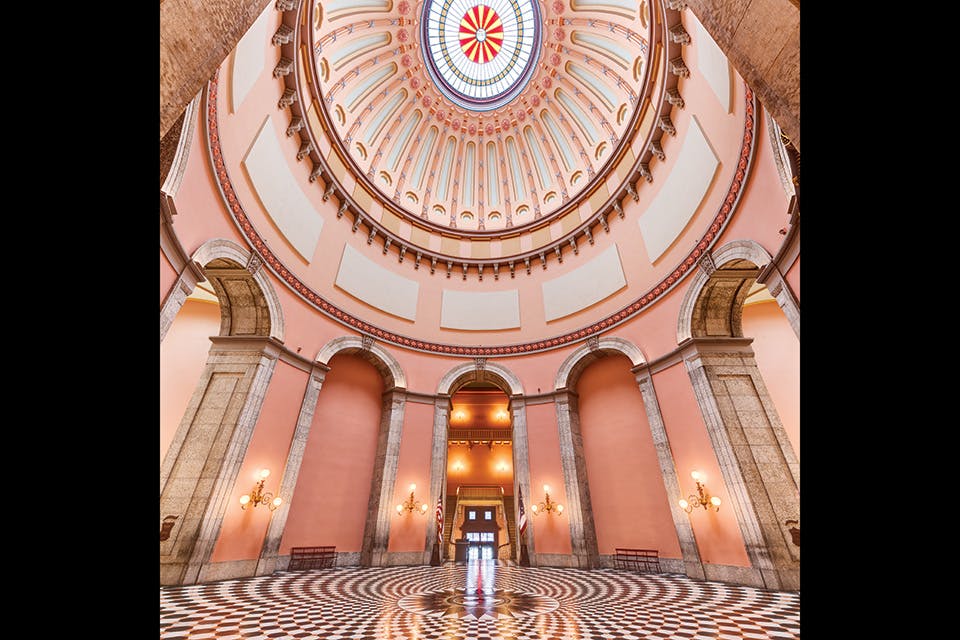
In Columbus, Lincoln dined at the Governor’s Mansion with Gov. William Dennison, and then addressed the legislature at the recently opened Statehouse, speaking to the differences between North and South as reporters hung on every word. A plaque in the State Capitol marks where he spoke. Lincoln also complimented the new Capitol’s elegant Greek Revival style before his train moved on through Frazeysburg, Dresden, Coshocton, Newcomerstown, Uhrichsville, Steubenville and finally, Wellsville, before heading into Pennsylvania.

He met Stanton in Cincinnati.

As a young attorney, Lincoln met the man who would become one his most valuable political allies while both worked on a case in Cincinnati. Ironically, it was not a pleasant or constructive meeting.

In 1855, Lincoln was brought to Cincinnati from Illinois to play a minor part in a patent-infringement lawsuit involving the famous McCormick reaper, a machine that helped revolutionize farming. There he met Edwin M. Stanton, one of the best and most prominent attorneys in Ohio, who treated Lincoln rudely and dismissively even though they were on the same legal team; historian Doris Kearns Goodwin notes that Stanton regarded Lincoln as an ill-schooled rube, and meanly called him a “long-armed ape.” Lincoln confessed to his hosts he had not much enjoyed his stay in the Queen City.

Six years later, however, President Lincoln offered the attorney from Steubenville the job of Secretary of War. Stanton ended up becoming one of Lincoln’s most vital cabinet members, and grew to be fervently loyal to the man he realized he had profoundly misjudged.

Another top advisor hailed from Ohio.

Another of Lincoln’s famed “team of rivals,” Salmon P. Chase, was also from Ohio. Born in New Hampshire, he moved to Ohio in 1830 and served as governor and senator before Lincoln named him Secretary of the Treasury — a key job when it came time to finance the Civil War. Chase became Chief Justice of the Supreme Court at Lincoln’s hand in 1864. He is buried in Cincinnati’s Spring Grove Cemetery.

His best generals were Buckeyes.

One could easily make the argument that the Civil War couldn’t have been won without the leaders who came from our state. The top two — Ulysses S. Grant and William T. Sherman — were born here, and their birthplaces can be visited to this day. Grant was born in a tiny white house in Point Pleasant, on the Ohio River east of Cincinnati; Sherman’s birthplace was a middle-class brick two-story in Lancaster that is now a museum.

In addition to those great warriors, who were also good friends, a slew of other leaders emerged from Ohio: colorful “Little Phil” Sheridan grew up in Somerset; cavalry hero George Custer was born in New Rumley; Irvin McDowell, who lost at Bull Run, was born in Columbus; James B. McPherson, killed at the Battle of Atlanta, came from Clyde; steady but imperfect William Rosecrans hailed from Delaware County; James A. Garfield, who later became the 20th president, was a brigadier general and came from Cuyahoga County. There were many others, much discussed by historians and Civil War buffs through the years.

We gave him fits.

Ohio also provided one of the greatest internal threats Lincoln faced in his prosecution of the war. The Peace Democrats who rose up to politically oppose the war effort, known as “Copperheads,” found their strongest leader in Ohio.

He was Clement Vallandigham, who was born in New Lisbon, worked as a journalist in Dayton and was elected to Congress, where he began vigorously campaigning against the Civil War — arguing that the federal government had no right to force states to stay in the union. He became such a thorn in Lincoln’s side that he was finally arrested for making treasonous statements and was exiled to the Confederacy, where Lincoln decided he belonged. The night he was arrested, his supporters in Dayton attacked and burned the offices of the rival paper that had opposed Vallandigham’s politics.

From Tennessee, where his federal escort dumped him, Vallandigham ran to Canada. From there, he campaigned on the Democratic ticket for governor of Ohio in 1863; if he’d won, he could have withdrawn the state’s soldiers from combat. When he lost, overwhelmingly, President Lincoln was most grateful.

But we gave Lincoln some laughs, too.

If Ohio produced the headaches that Lincoln had to endure from the

Copperheads, the state also provided him with welcome respite from the problem. That came in the form of a series of comic columns and editorials written by David R. Locke, a remarkable Ohio journalist who worked at papers in Toledo, Plymouth and Bucyrus. Though he is little remembered today, he created a wildly popular alter ego named Petroleum V. Nasby, an ignorant redneck whose ridiculous opinions and dreadful spelling were a reliable reverse barometer to what Lincoln would have thought on any matter, from slavery to secession. Biographer Donald writes that Lincoln read columns by “Nasby” aloud to Chase, Stanton and others in his cabinet, while laughing uncontrollably. “For the genius to write these things I would gladly give up my office,” the president said.

Ohioans guarded him.

In the days before the sort of Secret Service protection presidents get today, Lincoln was largely unguarded when the war broke out. The general in charge of the District of Columbia appointed the Union Light Guard, “a company of one hundred carefully appointed Ohioans mounted on handsome black steeds” to guard the White House in 1862, Donald writes.

Ohio was on the way home.

After he was assassinated on April 14, 1865, Lincoln’s funeral train went through Ohio on the way from Washington to his former home in Springfield, Illinois. It stopped in Cleveland, where huge crowds of mourners appeared, and in Columbus, where his body lay in the Statehouse — the same one he had so graciously complimented just a few years before as he made his victorious way to the White House.
 
Copyright © 2013 Ohio Magazine All rights reserved. | webmaster@ohiomagazine.com
1422 Euclid Avenue Ste. 730 Cleveland OH 44115