





March 2009 Issue
Road to History
Celebrate the Lincoln Bicentennial with a tour of the Kentucky Lincoln Heritage Trail.
As the birthplace of Abraham Lincoln, Kentucky is celebrating the Lincoln Bicentennial 1809–2009 in a big way. Events, exhibitions and special programs are planned along the Kentucky Lincoln Heritage Trail that links National Park Historic Sites, Kentucky state parks and a variety of locations that have strong connections to Abraham Lincoln, his family and his Kentucky friends and political supporters.
To encourage visitors to stop at all of the sites along the trail, Kentucky organizations have joined together in a special Passport Program that connects 16 of the sites along the trail. And, Kentucky state parks are focusing their Family Adventure Quest 2009 on Lincoln. There is a lot to see, so you may want to take a weekend to concentrate on the areas near his birth and boyhood, and another day or two to visit the sites from Louisville to the Lexington/Richmond area that are related to his adult friendships, marriage and political connections.
Heritage, Birth and Boyhood
The land rolls gently south of Hodgenville to the Sinking Spring Farm where Abraham Lincoln was born to Thomas Lincoln and Nancy Hanks Lincoln on February 12, 1809. The Abraham Lincoln Birthplace National Historic Site was the first national memorial to our 16th president.
The National Park Service maintains a comfortable visitors center with a small museum and an auditorium where you can view a new video presentation about Lincoln’s birth and his early years at the Knob Creek Farm site that NPS maintains north of Hodgenville. For interpretive purposes, the cabin that belonged to one of Lincoln’s boyhood friends has been reassembled on that site. “The cabin had almost collapsed,” says Dean Wigfield, exhibition specialist. “We’ve reset the 14-by-18-foot one-room, single-pin log cabin on the site of the original Lincoln cabin [and] used local clay mixed with hog hair to daub.” A peaceful valley stretches out behind the cabin adjacent to a larger log structure that will soon house an interpretive center.
Hodgenville is proud of its native son. Two Lincoln statues are the focus of Lincoln Square (within a traffic circle) in Hodgenville. Adjacent is Lincoln Museum Inc., Kentucky’s official Lincoln museum with a set of 12 room-size dioramas, each containing life-size wax figures and authentically furnished to represent major points in Lincoln’s life.
Nearby Elizabethtown has a collection of Lincoln campaign posters and buttons in the Hardin County Museum and sites related to Thomas Lincoln, his father, and Sarah Bush Johnston Lincoln, his stepmother.
The Lincoln Homestead State Park near Springfield has log buildings connected to Lincoln’s parents and a two-story white clapboard house owned by his uncle Mordecai. The focal point is the Francis Berry House where Nancy Hanks was living with her relatives when Thomas Lincoln proposed to her in front of the Berry House fireplace.
However, the cabin in which the marriage ceremony occurred was moved to Harrodsburg. To preserve the wedding cabin, a red brick chapel with a simple white steeple was constructed around and over it. “It has a look of a little church in the dell,” says Betty Williams, a staff member at Fort Harrod State Park, about the nondenominational Lincoln Marriage Temple. The adjacent Fort Harrod reconstructed stockade provides a glimpse into the harsh frontier life that the first Lincoln and Hanks families experienced when they migrated from Virginia in the late 1700s.
Kentucky Connections: The Road to Washington
Throughout Abraham Lincoln’s life, he was surrounded by other native Kentuckians, especially in Illinois as he began his political career and courted, then married, Mary Todd, a member of a prominent Lexington family. “Joshua Speed was about one of Lincoln’s closest friends,” says Andrea Pridham, director at Farmington, a meticulously restored ante-bellum mansion. “The friendship endured despite their differences. It was, it seems, their decision to agree to disagree.”
Farmington also has a new exhibition in the visitor center that examines Lincoln’s relationships with Joshua, who returned from Illinois to Louisville to manage the family’s hemp plantation that Lincoln visited in 1841, and James Speed, Joshua’s older brother, who became Lincoln’s Attorney General.
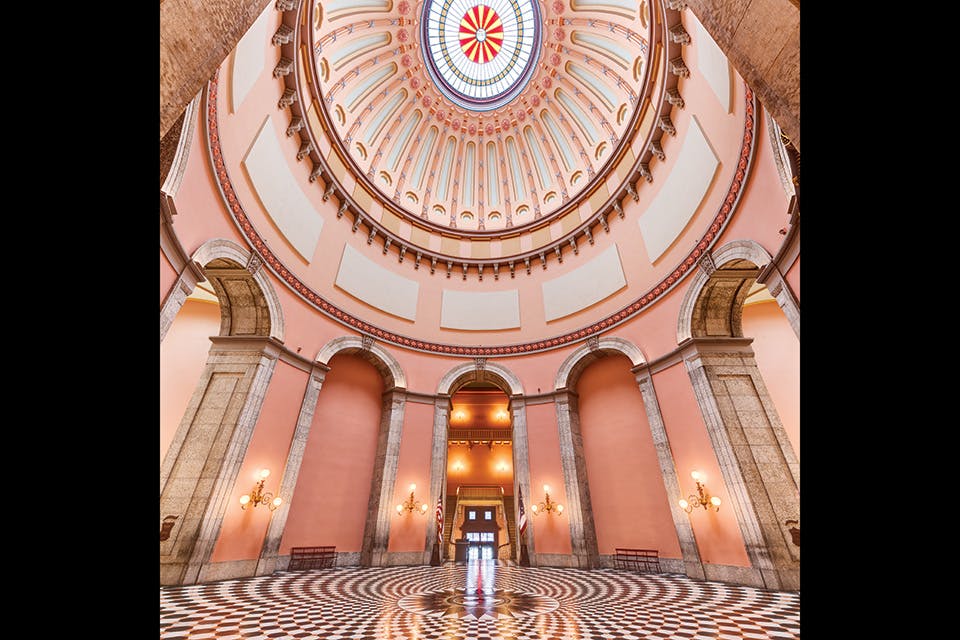
It was James who commissioned the moving, larger-than-life bronze statue of Lincoln that is centered in the Kentucky State Capital Rotunda in Frankfort. So many hands have rubbed the boot toe of the statue (said to bring good luck) that the patina has worn away. Sharing the rotunda space about 20 feet away is a statue of Jefferson Davis, who was the President of the Confederate states during the Civil War. Both Kentuckians, Davis was born eight months later than Lincoln and 80 miles farther west.
Central to the Kentucky Lincoln Heritage Trail is the exhibition “Beyond the Log Cabin: Kentucky’s Abraham Lincoln”
at the Thomas D. Clark Center for Kentucky History in Frankfort.
The displays include artifacts and stories from state sites and national and private collections. One of the highlights of the exhibition is Lincoln’s pocket watch from the center’s own collection, likely purchased at Tiffany’s in New York City. Other treasures include a “Free Soil, Free Man” campaign lantern and a fragile playbill for “Our American Cousin,”
the play Lincoln was watching the night of his assassination, from Ford’s Theatre. One display, AbeSpace, allows people to read relevant blog-style entries using Lincoln’s own words.
Lexington and nearby areas have a wealth of Lincoln and Civil War sites. The Mary Todd Lincoln House reflects her refined upbringing. “Visitors are very interested in seeing the room that the Lincolns stayed in and the White House china,” says docent Tom Wright. “We try to emphasize Mary Todd’s life; give an overview rather than talk about objects.” Abraham, Mary and their two sons stopped for a three-week visit in 1847 on their way to Washington. It was the first time she had been back since she left in 1839 to stay with her sister in Springfield, Illinois.
“We know that the Lincolns attended ‘The Market Speech’ given by [statesman and political leader] Henry Clay while they were in Lexington,” says Ann Hagen-Michel, executive director of Ashland, Clay’s estate in Lexington that is a National Historic Landmark. “What we have not been able to document is that they visited Henry Clay here, though the Todd and Clay families were very much connected in social circles.” During the bicentennial, Ashland will display a number of Lincoln documents, including Lincoln correspondence with other members of the Henry Clay family.
South of Lexington is White Hall, the plantation manor of Cassius Marcellus Clay, a cousin of Henry Clay and an emancipationist and political supporter of Abraham Lincoln. He was nominated, but not chosen, as Lincoln’s vice presidential candidate and later was appointed ambassador to Russia. “This year, our Ghost Walk programs will focus on slavery issues and the effects on the family,” says curator Lashe Mullins. Each October, drama students from Eastern Kentucky University enact nighttime presentations in rooms of the mansion that bring to life the strongly opinionated and very political Clay family men and women.
The Civil War and African-American History
Kentucky, a borderland state that never seceded from the Union, was the site of 11 major battles as determined by the Civil War Sites Advisory Commission of the National Parks Service. Two military sites have been included on the Lincoln Heritage Trail, the Perryville Battlefield State Historic Site and Camp Nelson Civil War Heritage Park.
“Because of the battle’s size and significance, and because Lincoln’s Emancipation Proclamation was issued during the Perryville campaign, Perryville is the perfect site to represent Kentucky’s Civil War heritage on the Lincoln Heritage Trail,” says Stuart Sanders, Civil War heritage specialist for the Kentucky Historical Society. The Perryville Battlefield is considered to be one of the most unaltered Civil War sites in the nation. It has seven miles of self-guided walking trails that wander across the former farmland, a museum, a Confederate cemetery and a Union monument. The battlefield is the site for annual Civil War reenactments.
Soon after the Civil War, the Sleet family, recently freed slaves, established Sleettown on portions of land that had once been part of the battlefield. “The Sleettown story, which discusses a family’s rise from slavery to freedom, is another compelling facet of the site,” says Sanders. Interpretive markers can be found on relevant sections of the walking trails.
Camp Nelson was established on 4,000 acres of land commandeered by the Union Army. A recruiting center for Union troops in Kentucky and east Tennessee, about 5,400 slaves enrolled at the camp, making it the third largest recruitment center for African-Americans. Slaves received emancipation upon enlistment and many brought their families with them hoping to help them escape slavery. The “White House on the Hill” as the soldiers called it, can be toured and is furnished as it would have been when used as a Union officer’s quarters. Camp Nelson also has a museum/interpretive center and trails. Nearby, a designated National Cemetery for the Union dead contains the remains of Camp Nelson soldiers, including 600 African-American soldiers and Civil War dead from several Kentucky Civil War sites.
Kentucky’s Lincoln Heritage Trail Sites
For general information on the trail, call 800/225-8747 or visit
www.kylincolntrail.com or
www.kytourism.com. An interactive map on the Lincoln Heritage Trail Web site offers details on specific sites.
To learn more about the Kentucky State Parks Family Adventure Quest 2009, log on to www.parks.ky.gov. This Kentucky-themed scavenger hunt offers a series of challenges that are focused on the bicentennial celebration of Abraham Lincoln’s birth.
Be the first to leave a comment.