




September 2011 Issue
September 2011 Digest
Pictures from the past, panning for gold, noteworthy brewery tours.
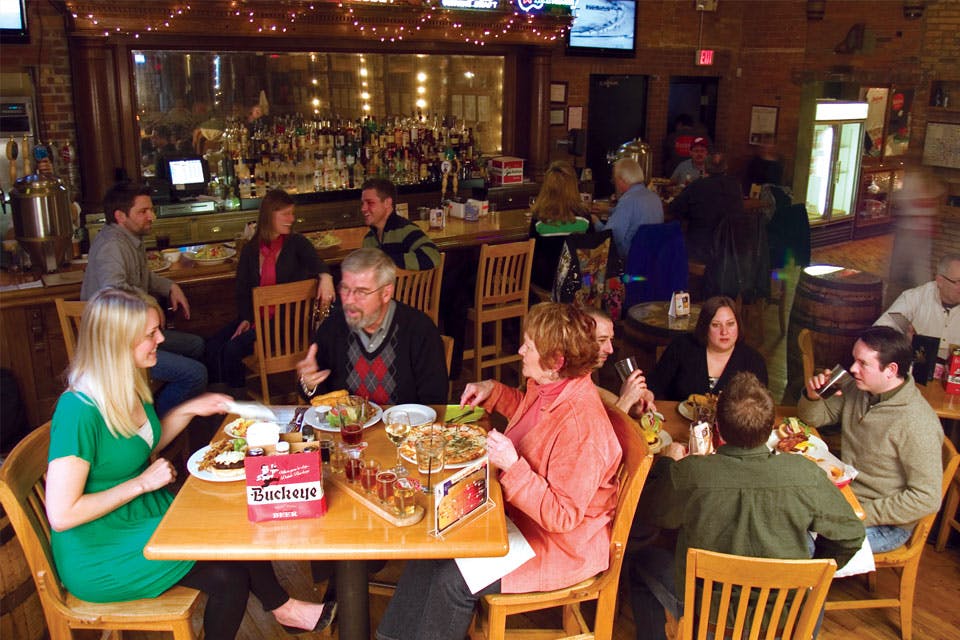
A new series of walking tours provides glimpses of Cincinnati's rich brewery history.

Daguerrotypes captured Cincinnati on an autumn day in 1848 by William S. Porter and Charles Fontayne.

Visitors to Lorain County Metro Parks Vermilion Reservation try their hand panning for gold.

Something's Brewing
Author Michael D. Morgan was shocked to discover that many Cincinnatians were unaware of the history associated with the Brewery District in their city’s Over-the-Rhine neighborhood.
But the Lager Tours, which emerged from twice-yearly tours Morgan helped create, are steadily changing that fact. The popular events, which sell out quickly, have been designed to educate participants about the district’s libationary past: The region was a thriving hub of beer production in the mid- to late-1800s, until Prohibition shut it down, leaving behind a neighborhood that was a deteriorating shadow of its former self.
“When I really started to get the history of it, I became blown away by what an amazing story this neighborhood has and how important it is on a national level,” Morgan says about one of the largest urban historic districts in the nation.
In fact, he was so fascinated after he started volunteering in 2005 for the Over-the-Rhine Brewery District Community Urban Redevelopment Corporation — a nonprofit organization dedicated to promoting restoration of the area — that he detailed the neighborhood’s colorful past in his 2010 book,
Over-the-Rhine: When Beer was King.
Drawing on the contents of Morgan’s book, walking tours commence at the Findlay Market for an hour-and-a-half-long sojourn through time. The most popular stop: the rubble-filled-yet-still-intact confines of the cellars of Jackson Brewery and its underground rooms and tunnels where lager was stored and transported.
Morgan is pleased with the attention the tours have received.
“One of the greatest things I can do with my life,” he says, “is help this city understand how to unlock the potential this neighborhood has.”
For more information, call 513/604-9812 or visit
cincinnatibrewerytours.com.
—
Ilona Westfall
Zoom into History
Details of early communities are often lost, buried in graveyards of modernization and memory. Now, however, the Public Library of Cincinnati and Hamilton County is offering a glimpse of a Cincinnati scene from 163 years ago.
Connecting today’s residents with a fall day in 1848, “The Cincinnati Panorama” is a series of daguerreotypes taken by William S. Porter and Charles Fontayne. The images, depicting two miles of Cincinnati landscape, span eight separate plates, which fit together in a horizontal, 8-foot display revealing a September day from the Kentucky side of the Ohio River.
According to Patricia Van Skaik, manager of the library’s genealogy and local history department, the project began as a restoration and conservation of the original image, and “… resulted in this treasure trove of data.”
The daguerreotypes were sent to the George Eastman House International Museum of Photography and Film in Rochester, New York, and, while stabilizing them, conservators used digital microscopy to take thousands of high-resolution photos.
The exhibit at the system’s main library displays the daguerreotypes, with an added dimension. The plates are accompanied by two touch-screen computers that enable visitors to zoom in to the digital images; some areas can be magnified 16 times, while others can be enlarged 32 times. It’s like a digital stroll into 19th-century America.
Library visitors can examine 30 specific points of interest and obtain more information about them, says Skaik. “That was one of the things that we wanted to capture — the everyday experience of living in mid-19th-century America.”
The main branch of the Public Library of Cincinnati and Hamilton County is located at 800 Vine St., Cincinnati 45202. For details, call 513/369-6900 or visit
cincinnatilibrary.org.
— Sandie Young
All That Glitters
Don’t expect to become a millionaire panning for gold in Ohio. There is no mother lode, but small amounts are found in the glaciated two thirds of the state. Today, gold dust can be recovered from several Ohio streams.
“Gold is heavier than iron, so it settles wherever a stream slows up. That means behind a big rock, bridge jetty or log,” says Grant Thompson, chief
naturalist, Lorain County Metro Parks.
That is where gold seekers looked during the Western Reserve Land Conservancy’s gold panning event at the Vermilion Reservation in July. Families,
individuals and hobbyist gold panners waded into the river, swirled pans filled with sand and gravel and squished mud between their fingers searching for the prize.
Panners sometimes mistake iron pyrite for gold because it is a “brassy, platinum color,” according to Thompson, who holds several public and small- group
private panning events a year.
“But gold doesn’t corrode. When you find gold in the river, it is the same color as the ring around your finger,” says Thompson. “For the most part, it is 24-karat gold, the way nature made it.”
Most gold found in Ohio is in the form of flattened flakes about a millimeter or less in diameter. But while there is excitement in discovering the tiny bits of metal, many panners just enjoy the river and the activity itself, as well as other discoveries. Some panners in the Vermilion River find “turtle rocks,” pseudo fossils that look like the shells of turtles, found in limited locations in the United States.
And to kids, some discoveries are better than gold. According to Kate Pilacky, associate field director of the Land Conservancy’s Firelands Chapter, two little girls who were panning were excited to find two dead crayfish.
For more information on panning in the Lorain County Metro Parks, visit
metroparks.cc. For more information about gold in Ohio, read GeoFacts No. 9 at
dnr.state.oh.us.
— Jill Sell
Be the first to leave a comment.