


March 2008 Issue
Still on Track
The Cincinnati Museum Center at Union Terminal celebrates 75 years of being much more than a mere train station.
It’s a scene that plays out every day at Cincinnati Museum Center at Union Terminal. First-timers amble up to the oversized doors, yank hard on the tubular handles and march toward the information kiosk. They take a few more steps and then, suddenly, they freeze.
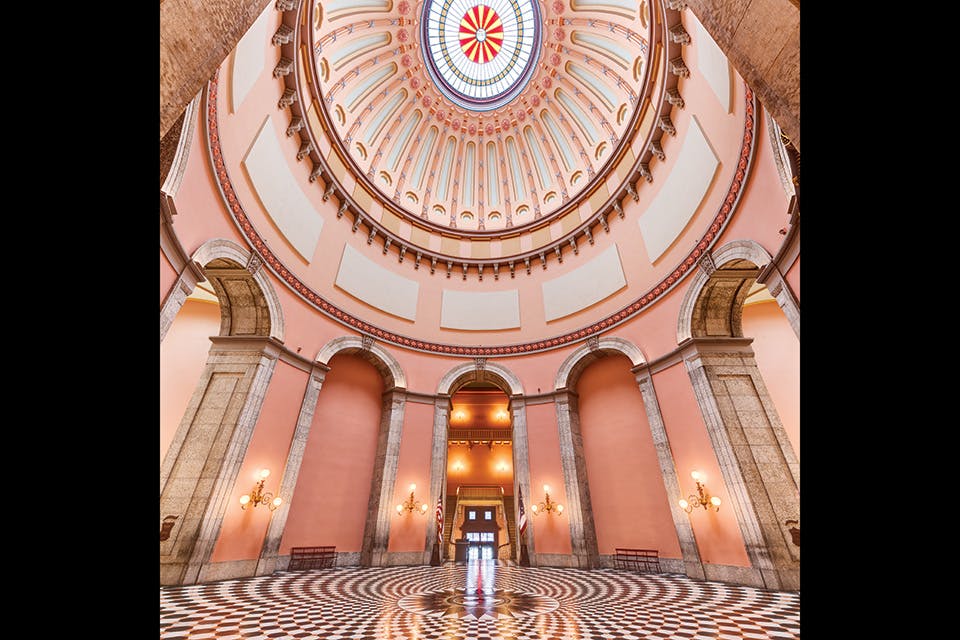
Craning their necks, they gawk up 106 feet to the top of the rotunda –– and take a vertiginous moment to steady themselves beneath the bright yellow half-dome, the world’s largest when it was built in 1933 (only the Sydney Opera House has topped it since).
That awestruck reaction first-timers have today is the same one Ohioans had when Union Terminal opened 75 years ago as America’s great, Art Deco pantheon to the locomotive. Visitors were stunned to see such innovations as aluminum trim and elegant, indirect lighting adorning a structure as big as 14 football fields, and the building quickly became a destination for rail and architecture buffs from around the world.
Today, Union Terminal is also beloved for being home to some of Cincinnati’s most popular institutions. And this year, both enthusiasts and families in search of a fun time have even more reason to make their way to the southwest Ohio spot, thanks to a wealth of special events (page 61) planned to pay tribute to this National Historic Landmark.
Seen from above, Union Terminal resembles a giant funnel. The 10-story rotunda and wings, encompassing the Cincinnati History Museum and Museum of Natural History and Science, form the bowl. The Presidential Suite and Amtrak Station run along the stem, which once ran to the concourse and rail tracks and now culminates in the OMNIMAX Theater.
The terminal was conceived in the Roaring ’20s by seven railroad companies, built to replace five stations scattered around downtown Cincinnati. During World War II, the circular walls bulged with soldiers in uniforms, and the government even added two tracks to handle up to 34,000 passengers and 465 trains per day.
Looming over all those station visitors was the colorful artwork that remains one of Union Terminal’s trademark details. Sweeping high along the rotunda walls in a kaleidoscope of color are two epic tales: America’s westward expansion, and Cincinnati’s own progress –– from 1788 to the 1933 of airplanes and skyscrapers. Winold Reiss, a German immigrant who won the contract for decorating the immense space, insisted upon glass tile mosaics rather than painted canvas to best survive the sooty atmosphere. One look at the exquisite, still-vivid detail in the faces and clothes of the 12-foot figures, and visitors see how right he was — even if Reiss did have to fund the mosaics with part of his own pay. Reiss also used his son, Tjark, as a model in the artwork, depicting him as the surveyor in the rotunda’s westward scene, and as a farmer with a scythe in a panorama of Cincinnati.
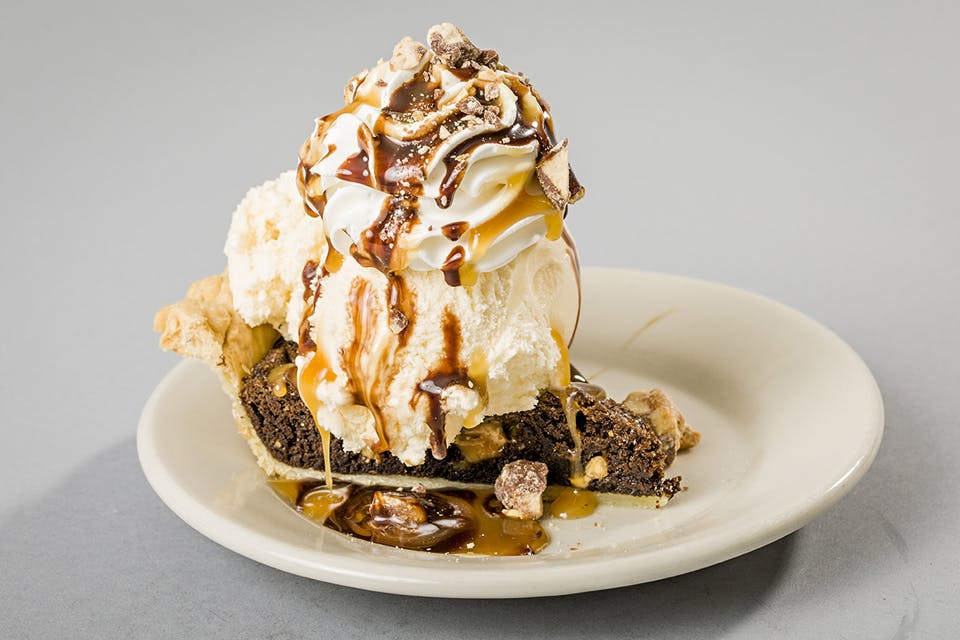
Union Terminal’s Tea Room used to occupy space beneath the Cincinnati mural, and was converted to a USO headquarters during World War II. Today, that space is the Rookwood Ice Cream Parlor, lined with Rookwood pottery in the distinctive spring-green dragonfly pattern. Rookwood, made just up the hill in Mount Adams, was one of the nation’s foremost art potteries for decades after its founding by Maria Longworth Nichols Storer in 1880. The tile cost $6,000 at installation. Today, it’s priceless.
After the war, with the decline of railroads and the ascendancy of the car, Union Terminal suddenly seemed like a massive white elephant looming over the Cincinnati landscape. The last passenger train pulled out in 1972, and the concourse above the tracks was pulled down a year later. In 1975, the city bought the land for $1 million, and was able to purchase the terminal for $1 and its contents for another buck.
Union Terminal hobbled along as a shopping center until voters approved a $34 million bond levy in 1986 to gather most of the city’s major museums from the city center under one gigantic roof. In November 1990, the Cincinnati History Museum, Cincinnati Historical Society Library, Cincinnati Museum of Natural History & Science and Robert D. Lindner OMNIMAX opened in the Terminal.
Since, Duke Energy Children’s Museum and Arts Consortium: African American Museum have joined the fold. Amtrak brought its passengers back in 1991.
After years of neglect, the building needed some serious TLC. It arrived in the form of bond levy funds, but much more came from the elbow grease and dedication of Museum Center personnel and volunteers, such as the Cincinnati Railroad Club. Together, citizens restored the water-streaked Presidential Suite, the power center composed of the secretary’s office, a boardroom and the president’s office, all clustered in the terminal’s heart.
Just step into the secretary’s office and it’s all sleek, built-in filing cabinets, maple-veneered walls and a Brazilian rosewood desk. Next door is the inner sanctum, the railroad president’s office: a round retreat with cove ceiling lights and rich wood veneers. The stylized deco andirons were salvaged by a city worker in 1977, kept safe in his office for 22 years, and then returned after the restoration.
Just outside the boardroom, a stray train gate sign points the way to Ironton. Saved from the concourse, the gate may be in an incongruous spot, but terminal fans cheer its survival.
Some of the original terminal, such as the concourse that once covered the rail tracks, is gone forever. Other parts, such as the concourse’s mosaic murals, were moved to safety by visionary citizens — to the Greater Cincinnati/Northern Kentucky International Airport.
And yet other parts of Union Terminal remain just as they were in 1933. Docents always encourage visitors to pop into the rotunda’s Newsreel Theater on weekends, where the latest World War II films from the front sometimes play. The seats may not be as comfortable as those at the local multiplex, but they’re certainly historic. Just tuck your hand underneath and you’ll touch a bent metal rod — a necessity to hold the hat that each proper gentleman always wore.
Be the first to leave a comment.