



Printer Friendly VersionEmail A FriendAdd ThisIncrease Text SizeDecrease Text Size
November 2008 Issue

Sundays Without George

Recalling the empty space in the family photo, the man who wasn’t there – and should have been.
Sundays Without George
This Veterans Day, I will slip off to a quiet place to think. But I will probably dream of pie.

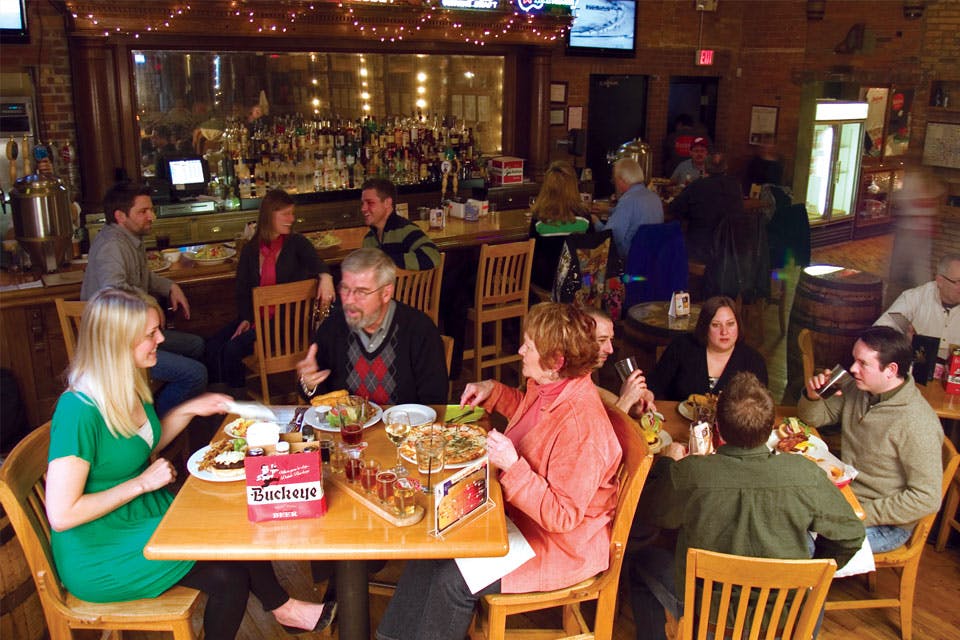
It is one of my earliest and sweetest memories. As a small boy I would join my family for Sunday dinner at my Grandmother Colino’s house.

You got a good seat and waited for the show. Soon the storm door would bang open, like the cannon announcing a circus. Here came Guido and Pasqualine, a tiny gray-haired couple so devoted they never drifted more than a few feet from each other. There was Dominic Marconi, who was always called by two names — Dominic Marconi — to prevent him from being confused with any other Marconi, I supposed. I recall a pretty woman named, I swear, “Two-Gun Pete,” and the Favoritos, a happy clan whose number seemed to increase with each visit.

The adults ranged from young parents with bawling infants to elders my grandmother’s age — which I estimated to be in the 100s. I knew that most of these “aunts” and “uncles” had no blood ties to me. But they had been fixtures at our table since Noah left the ark, and their friendship was constant as the clouds.

The women were a terror, especially to small boys, as they were prone to kissing.

When the house was full to bursting, we ate. Thanksgiving came four times a month then. My grandmother baked yards of lasagna, pulled sheet pizzas as big as church windows from her oven, and always served a roast. The young women brought covered dishes, and only a few were broccoli casserole. We would crowd around one table to eat and argue until it was not humanly possible to swallow another bite.

Then we would have dessert.

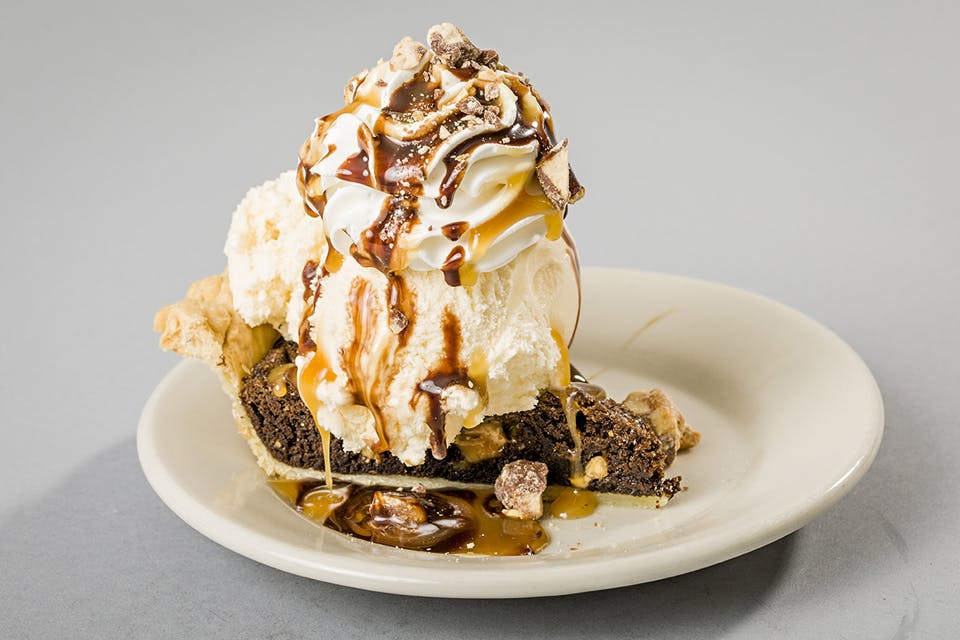
Mostly I remember the pies. My aunts baked mountains of sweetness so high you wondered if there was an apple or berry left in the state.

Later the boys would toss a football, risking life and limb and our church pants. The women would adjourn to the kitchen or the cleared table to do … I wasn’t exactly sure what. I recall once going inside for a glass of water. In the dining room I could see the old women gathering around my grandmother.

I must have passed that table a thousand times. But that day I noticed the empty chair.


*****
He was something to see, the day he left in his uniform.

He was my uncle George Colino, and by the time he marched off to World War II he had lived a life lit by the glow of radio tubes and stitched together with copper wire.

His baptismal certificate read “Dominic,” but he had come into this world on Washington’s Birthday, so folks nicknamed the baby “Little George.” His parents liked the sound.

Home was the hard side of Cleveland. The frame houses on West 34th Street seemed to lean on one another, and the people inside really did, to get by. The Favoritos — there were only a handful back then — lived down one block, and the Marconis with baby Dominic lived up the other. Dark-haired Guido and his new bride Pasqualine set up housekeeping nearby.

My grandfather, John Colino, made steel in a mill that was not much more than hell with a lunch break. My grandmother, Gemma, raised babies using Solomon-like wisdom enforced by the business end of a corn broom. George was the oldest child and only son. My aunts called him “a devil,” but they were always grinning when they said it.

George had a head of thick, wavy black hair and a smile as yet unencumbered by much modesty. At St. Rocco School, George made A’s and B’s. The nuns doted on him, and in turn he broke only the misdemeanor commandments.

Stray dogs followed him home, although some required a bit of coaxing and most of his lunch. Radios fascinated him. He built a crystal set out of scavenged parts, and sent the tinny voice of “Mr. Keen, Tracer of Lost Persons” drifting through the halls.

He was no angel. When he got something in his mind, George was a stone rolling down a hillside. He was not spoiled; he was just one of those people who could not tolerate a wasted day.

For his seventh birthday, George got the Great Depression. It did not slow him down much.

Then he nearly burned his family’s house down.

A neighbor swore pennies could replace store-bought electrical fuses. My grandfather listened: fuses cost real money and a penny was, well, only a penny. He decided to consult an expert; after providing a lecture on the conductive properties of copper, George said, yes, it should work. George was about 10.

Things went fine, until someone flicked a switch. Every outlet in the house began to spark, and the lights flickered like the governor’s pardon had not come through. John ran to the basement fuse box. A neighbor pulled the corner fire alarm.

The family had been in no real danger, but my grandfather was certain he had fractured some statute: abuse of Lincoln perhaps. After replacing the fuses, John climbed his cellar stairs like the gallows, certain Eliot Ness himself would be waiting.

In his mind my grandfather saw handcuffs, closing.

In his kitchen he found firemen, eating.

Supper had been simmering on the stove: There was a big pot of meatballs in red sauce, homemade spaghetti, a block of good cheese, and warm bread. Even as a young woman, my grandmother’s kitchen skills bordered on sorcery. The firemen stared. Gemma lifted a saucepot lid and let nature take its course.

After a second helping, the captain rose, tipped his hat to my grandmother, and ordered the company back to the firehouse. But first he left two men behind to dry dishes.

George hid until dark, but my grandfather would never have beaten him. He would have let my grandmother, though.

Then childhood fell away, revealing Tom Edison.

George won blue ribbons in science fairs at West Technical High. His teachers said he was destined to be an inventor. They could see his name in bronze on a building someday. He might have even gone to college, if the world had not wobbled.

The family still listened to the radio — they had a store-bought one now — but the laughter was darkened by bulletins from Munich and Dunkirk and London. George knew about scrapping with bullies. Hitler was just another bully, only in a bigger schoolyard. My uncle enlisted in the Army. They made him a Tactical Sergeant in the Air Corps.

I have seen a photo of him in his uniform. He looks like the Mayor of Handsomeville.

The Army showed him the world, although large parts of it were on fire when he arrived. George was a radio operator and a gunner on a B-17 bomber. On April 12, 1944, he flew into Austria. His plane never returned.

My mother remembered there was a knock on the door.


*****
What I know of my uncle I have pieced together from stories my aunts told me before they winked out, one-by-one, like candles on a birthday cake. They tried hard to show me a small boy, and I have tried just as hard to imagine a grown one.

My aunts did not polish their loss like an heirloom and hand him down, bitter. They doled him out a little at a time … sweet, like pie.

I cannot say why that empty chair touched me so. My family did not rope off furniture or talk to spirits. But George’s loss shaped me as surely as if they had. He was the empty space in the family photo, the man who wasn’t there — and should have been. He was the reason an otherwise solid family always seemed to wobble a bit, like a table with one too-short leg.

When I was small I wondered what Uncle George would have made of me. I think we might have built radios. I know he would have brought me a dog.

Across Ohio, on consecrated grass and in paved squares, Veterans Day will be observed. We will honor the living who served, and remember those whose lives have vanished into the ground.

George’s never did.

There were no remains, and a poor family does not buy a coffin to hold a knock on the door. But George did get his name on a building in bronze.

“Dominic C. Colino” is inscribed into the War Memorial in downtown Cleveland.

I go there to think sometimes. I always dream of pies.

John Hyduk is a Cleveland writer who misses those family dinners. He believes he will never see that much food unless he buys a restaurant.
 
Related Categories
- Life


Subscribe
COMMENTS
Sunday, October 30, 2011 by Ken Young
So hard to believe I would be the first to leave a comment. Has no one else read this? Has anyone read "The Loading Dock Manifesto" in Esquire magazine? (Esquire May 2011 ((page 92))
What will it take to get this man published?
ADD YOUR COMMENT


Copyright © 2013 Ohio Magazine All rights reserved. | webmaster@ohiomagazine.com
1422 Euclid Avenue Ste. 730 Cleveland OH 44115