



March 2009 Issue
Where Spring Begins
Schoepfle Garden offers magic among the maples and magnolias.
This is actually a county-funded time machine. The modern world stops at the garden’s edge.
But not envy, or pride.
I could do this, thinks anyone who has ever hefted a trowel, just looking at Schoepfle Garden. Then come rows of rhododendrons, daffodils, daylilies, roses — and humility.
No, you couldn’t.
Or, then again, maybe you could, over a lifetime.
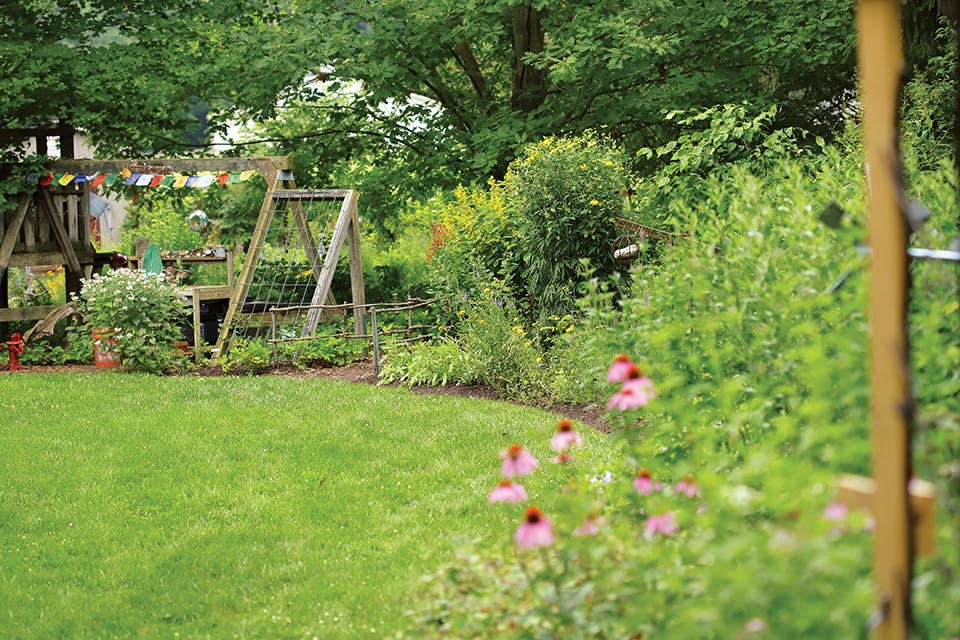
Located along the Vermilion River, Schoepfle Garden — 70 acres of carefully cultivated beauty set in a rugged woodland frame — is proof that there are still places in Ohio where a person can not only find the path to joy, but actually walk it.
I like to sit here in spring; I walk in summer and autumn. And I do not love it in winter so much as require it. The paths under the pines here are quiet as a cloister then, and nothing much grows except serenity. And that is inside me.
The Lorain County Metro Parks has maintained this vest-pocket Eden as a free-to-the public sanctuary since 1969. From a distance the garden looks like something painted on canvas, then tacked to the sky. But I believe that the flowers hide a far darker secret. This is actually a county-funded time machine.
I am a grown man. But when I come here I am a boy again, playing hooky.
Birmingham is an unincorporated community in Florence Township, 80 miles east of Toledo, two hours north of Columbus, and 40 minutes west of Cleveland. A strong wind can blow your hat into either Erie or Lorain County, depending where you are standing on St. Rte. 113. The township population numbers 2,500 if everyone is home. I think there is one stoplight.
There does not appear to be enough room to hide a time machine. But a wizard did live here.
Otto Schoepfle made his living in a suit and shiny shoes. He was a banker and a newspaperman, they will tell you at the visitor’s center. In 1936 Otto purchased this farm and moved into a house that still stands. He spent the next 56 years of life filling every inch outside his door with fanciful plants he’d heard or read about, alongside more familiar flowers, arranged in fanciful combinations. What he thought up under a straw hat has outlived even him.
“[Otto] did not start out to create a botanical garden,” says a brochure from the visitor’s center. “He in fact referred to it sometimes as ‘the garden that grew’.”
It is not the neat beds of daffodils and Henry’s Lily and Lady Rollestons, lovingly planted along a winding garden path that makes me wonder. That is just sweat. You can buy a garden book to tell you how to do that.
But to raise a shady stand of spruce so straight and tall it looks like a telephone pole farm? And grow a magnolia tree, and paperbark maple, not from saplings but from seeds? It seems like green magic.
Consider the Japanese hemlock, runty and gnarled as a fairy-story gnome, a tree that leans forward so that it looks about ready to leap the South Street fence and take off down the road. And the purple beech tree, about the circumference of a 50-gallon drum, that was well mannered until it grew about waist-high, then lost its mind. Branches thick as a man’s arm shoot out at crazy angles, like Mother Nature’s party favor.
It must be a spell.
Otto did not have to look far for inspiration. In addition to the 20 acres of formal garden, Lorain County Metro Parks maintains 50 acres of adjacent woodland. Step inside, and the wildness comes down like a cool green curtain. There is relief, like ice cream on a hot day.
I took a friend walking here, through the spooky woods. She eyed the vines snaking across the path toward her ankles with suspicion. (After a rain they grow so fast you can almost see them moving.) I told her not to worry. I am no Indiana Jones, but I can outrun a plant.
You emerge in the 19th century.
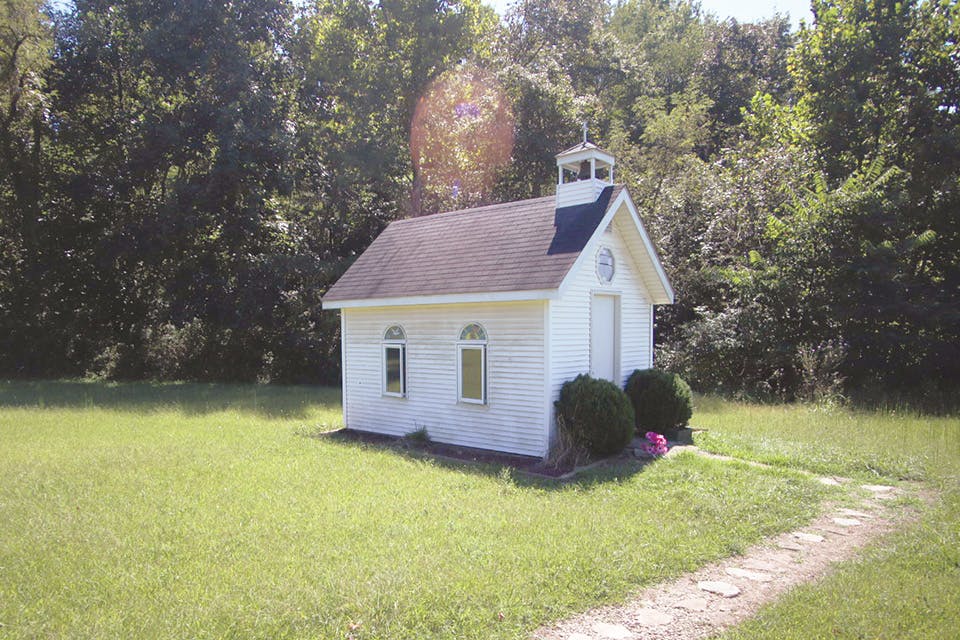
The Birmingham Methodist Church, founded in 1840, sits on the other side of the woods — wooden and brilliant white, as you might expect. They hold chicken dinners and ice cream socials, and you might expect that, too. Some country churches offer modern services — I have seen promises of addiction counseling on churchyard signs. I have few addictions, if you do not count ice cream and chicken dinners, so I am of two minds about that.
Next door is the Birmingham Community Center. The old baseball backstop in back is weathered gray and the diamond grass-covered. I do not think any innings have been played in recent memory. Which is good, because a foul ball now would find only tombstones, and disturb the Darbys and Suters and Berkmeyers who rest there. Birmingham Cemetery crowds the right field line.
As entertainment, a graveyard is about as economical as it gets. I like to walk among the markers, reading the dates and inscriptions, imagining. I met Perez Starr here, who passed in 1850. In a sea of stones proclaiming Husband or Beloved, Perez wished it be noted he was “formerly a resident of New London, Conn.” It is as though Starr wanted to be sure his mail delivery would not be interrupted.
Sunday morning the hymns drift out the church windows and tangle in the forest branches. Back in the garden there is another kind of music.
It is not hard to be alone at
Schoepfle Garden. It is impossible. Otto dug two ponds and critters soon made them home. Bluegill peer up from the shallows. Bullfrogs splash from hidden places along the bank, and during mating season the high grass sounds like an opera house. There is a stand of bamboo nearby. Bamboo is about as “Ohio” as the hula. But it fits here.
We are all transplants, I guess.
In winter, the thought of green growing things only colors the bleak, like a picture of palm trees stuck on a refrigerator door. But soon, the world will start again.
I will be here in March, watching parks workers in rain slickers prepare the beds. I suppose I am a nuisance, like a man in a woman’s kitchen, asking when supper will be ready. The nice lady at the visitor’s center has never come out, slapped me and sent me on my way. But someday she might.
April brings optimistic people in shirtsleeves hoping for an early spring. We usually shiver through the last snow of the season instead.
By Memorial Day canna plants will crowd the walkways like small creatures waiting to be petted. Then come the hostas — varieties with names like Bright Lights and the Sport of Antioch. (I am sure there is a story attached to that.) The roses blooming outshine any July fireworks. The antique types, folks here will tell you, were grown for medicine. I believe all roses are good for the heart.
I will walk, on the lookout for power cables, listening for machinery.
For now I am a boy, dreaming of summer vacation. I even make childish promises, to hurry spring along.
This year I promise not to spoil any more weddings. Wedding parties come to have portraits taken, and I am prone to shamble into the frame. In my head I imagine the photo albums I must have sullied, and I am ashamed.
I will accept the new children’s carousel — the flowers make me a little dizzy, so shouldn’t the littlest visitors sample that same joy?
And I promise to always take one last look back as I leave, in case it really was magic, and I have broken the spell. Or accidentally kicked out the secret power cord.
In a world that often makes us look away, a garden invites us to look again, closer. In the end, it is a place where friends and neighbors can walk. Maybe that is the only magic.
Ask Ohioans for the name of their favorite garden, and they will offer an opinion. Some will praise the Hauck Botanic Garden in Cincinnati, especially when the azaleas are in bloom. Others mention the Fellows Riverside Garden in Canfield for the crocuses, and their eyes shine. Galloway folks are as partial to the free-ranging wildflowers along Darby Creek as I am to Otto’s garden.
That plot of dirt, we will all claim, is the most peaceful place on Earth.
We are all telling the truth.
Be the first to leave a comment.